Conversational commerce platform, the five stages it has to close
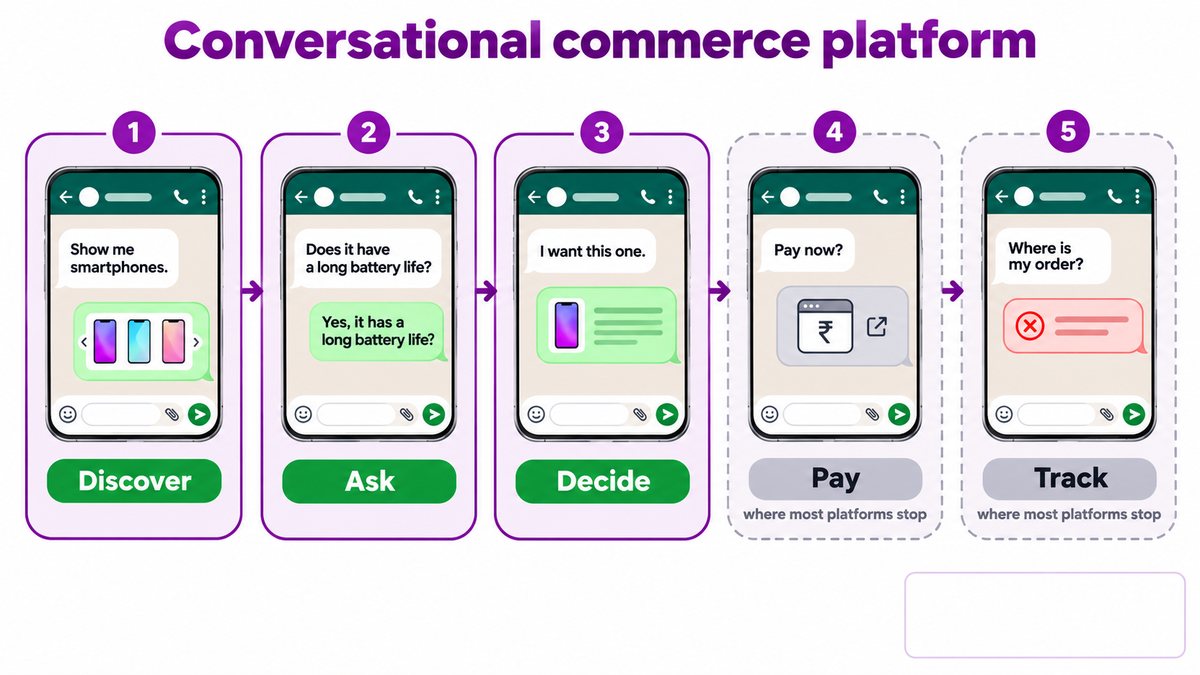
Table of Contents
What a conversational commerce platform has to carry
Five stages happen in a buying conversation. Discover, ask, decide, pay, track. A conversational commerce platform is judged on how many of those it can complete inside the thread, and most stop at the third.
Stopping at the third means the customer gets a link and leaves. At that point you have a chat widget with a checkout attached, which is a different and much weaker product.
Conversational commerce vs ecommerce
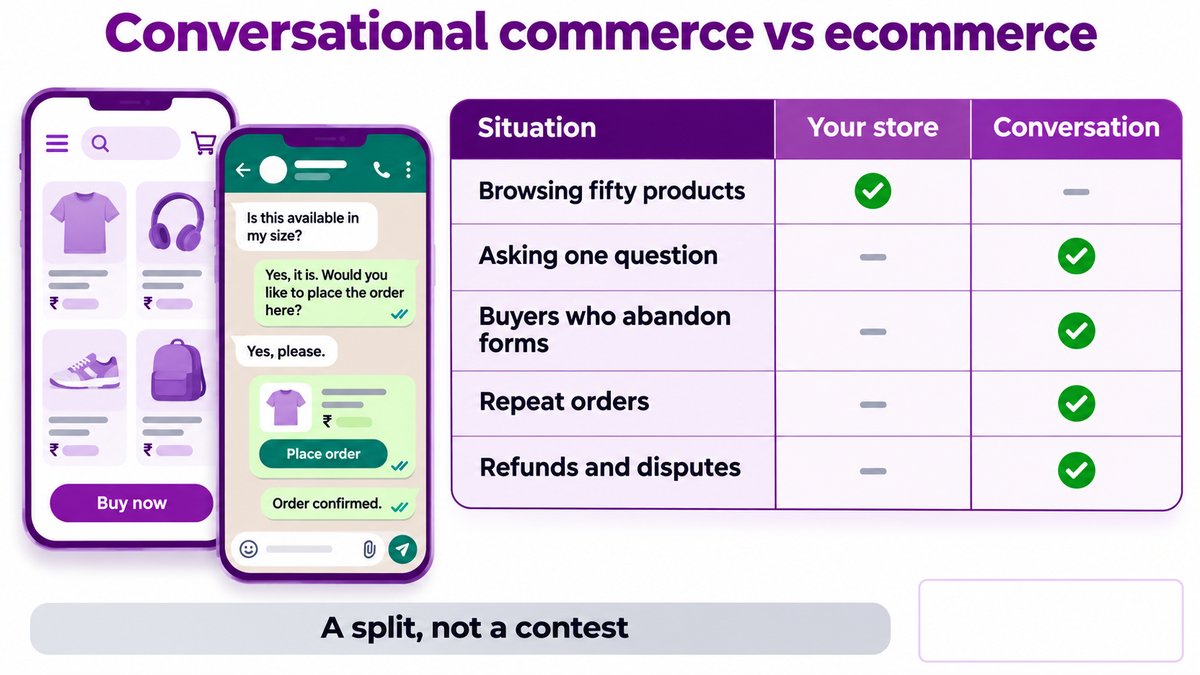
This is the wrong question as usually asked. One does not replace the other, and a conversational commerce platform that is sold as a store replacement is being oversold.
Situation | Stronger | Why |
|---|---|---|
Browsing fifty products | Your store | A grid beats a conversation for scanning |
Asking one specific question | Conversation | A search box cannot answer "will this fit my model" |
Buyers who abandon forms | Conversation | No form to abandon |
Repeat and replenishment orders | Conversation | "Same as last time" is one message |
Refunds and disputes | Conversation | A thread is a record both sides can read |
Read it as a split rather than a contest. The store handles discovery at scale, the conversation handles the cases where a question stands between the customer and the order.
Where conversational commerce genuinely loses
Anything the customer wants to do without talking to anyone. A simple reorder of a known product, a download, a renewal. Forcing those into a conversation adds friction rather than removing it, and a conversational commerce platform pushed into that job will underperform your checkout.
Conversational commerce tools india, the four pieces
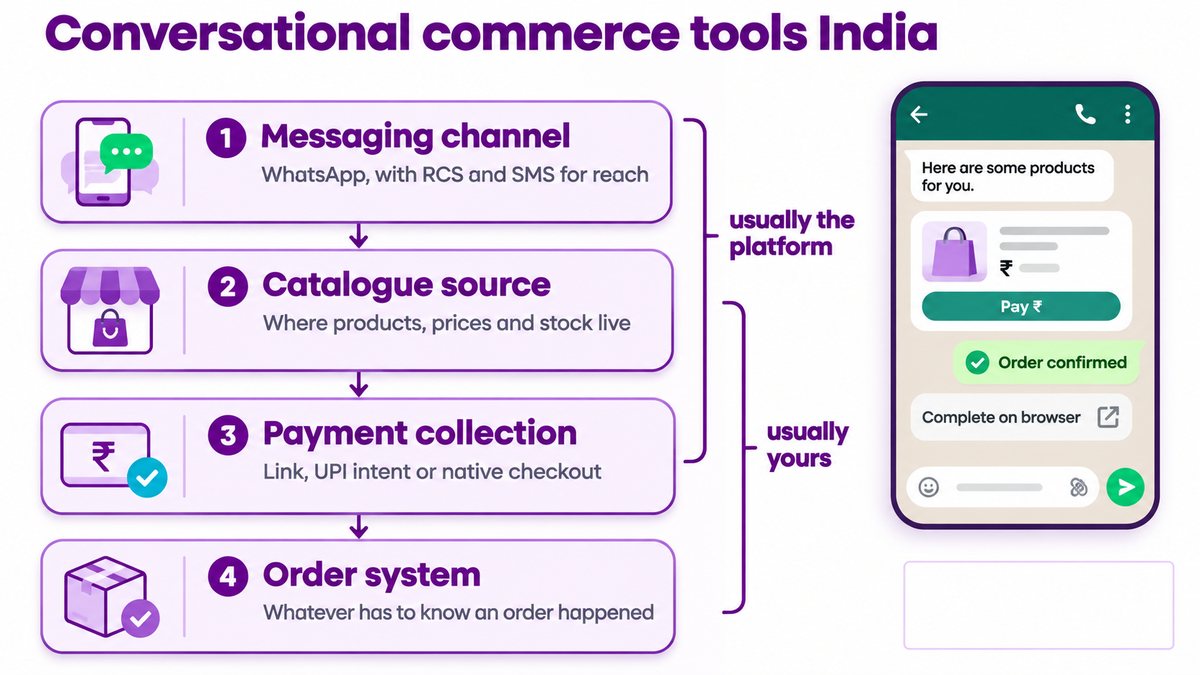
Messaging channel. WhatsApp in most of India, with RCS and SMS as the fallbacks for reach
Catalogue source. Where the products, prices and stock actually live, usually your store
Payment collection. A link, a UPI intent or native checkout, each with different drop off
Order system. Whatever has to know an order happened, so the warehouse ships it
A platform that owns only the first piece is a messaging tool. Ask which of the four it owns and which it expects you to wire up, because the integration work is the real cost of the project and it rarely appears on a pricing page.
The catalogue side is in our WhatsApp catalog integration post, and the channel choice in CPaaS against CCaaS and UCaaS.
What the platform cannot fix
Your stock data. If the catalogue says available and the warehouse disagrees, a conversation makes that worse than a store page does, because the customer is talking to someone who told them it was in stock. Fix inventory accuracy before adding a channel on top of it.
Conversational commerce examples that work
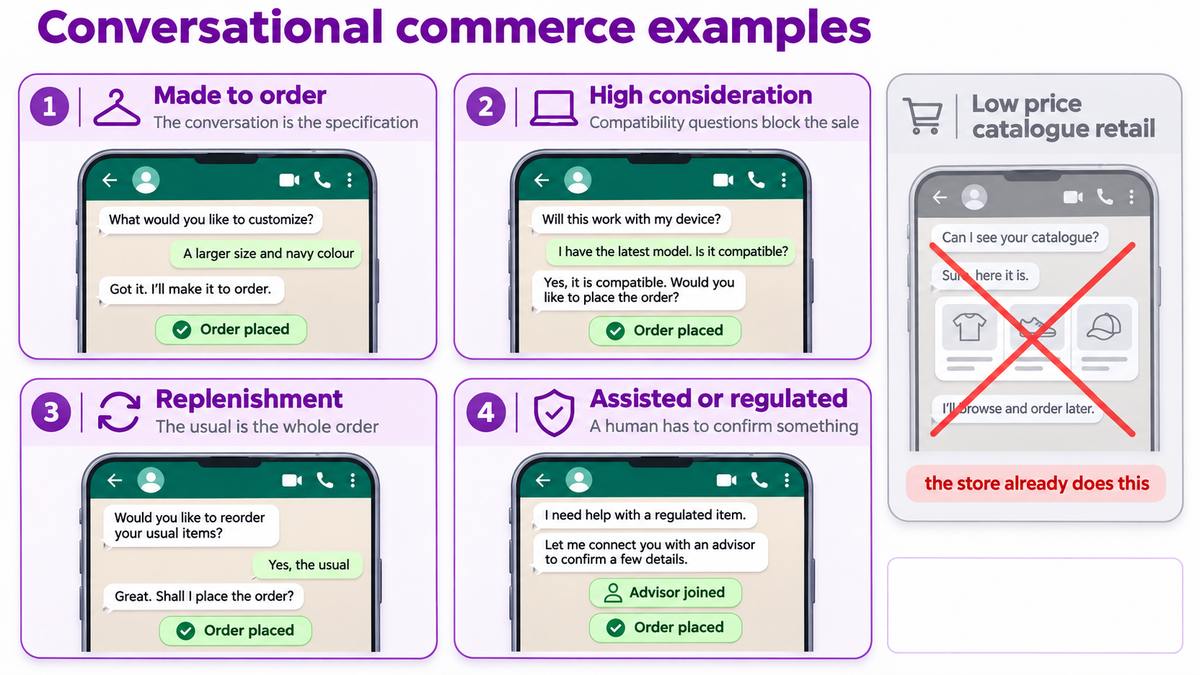
The strongest cases share one trait. Something about the purchase cannot be settled by looking at a page.
Made to order and customised. Size, fabric, engraving, dimensions. The conversation is the specification
High consideration with real questions. Equipment, furniture, anything with compatibility
Repeat and replenishment. Pharmacy refills, pet food, consumables, where "the usual" is the whole order
Regulated or assisted sales. Insurance, finance, categories where a human has to confirm something
Note what is missing. Standard catalogue retail at low price points is not on the list, because there the store already does the job and the conversation only adds cost per order.
There is a volume test worth applying before any of this. Each conversation costs a message fee and, eventually, a person's attention.
On a thin margin product with no questions attached, a conversational commerce platform can lose money on every order while the dashboard shows the channel growing. Work out cost per conversation against contribution per order first.
If that answer is uncomfortable, the fix is a narrower rollout rather than a cheaper platform. Pick the two categories where questions genuinely block orders and leave the rest on your checkout.
Not every category is permitted either. Meta's commerce policy prohibits fourteen product categories outright, which is covered in selling products on WhatsApp.
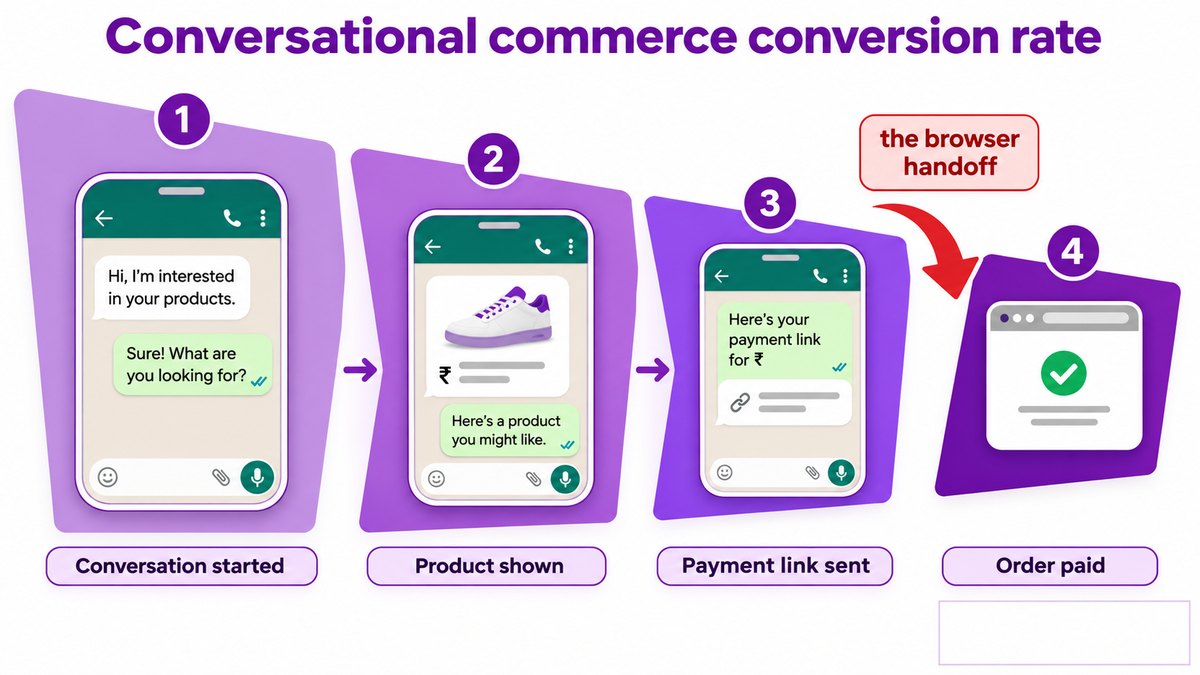
Conversational commerce conversion rate
Four steps, measured separately. One headline number tells you nothing you can act on.
Conversation started. How many people opened a thread at all
Product shown. Did you get as far as a specific item
Payment link sent. Did the conversation reach an intent to buy
Order paid. The only one that counts
The drop between the last two is usually the biggest and the most fixable. A payment link that opens a browser undoes the reason the customer was in the conversation, which is why native checkout matters more than it sounds. See in chat purchase on WhatsApp.
Compare each step against your store's equivalent, not against a figure from a case study. A conversational commerce conversion rate only means something next to your own checkout on the same products.
Payment, the stage that decides the whole thing
This is where a conversational commerce platform either earns its name or does not, and it is worth understanding the three options before a demo.
Method | What the customer does | Where it leaks |
|---|---|---|
Payment link | Taps out to a browser page | The tab, the load, the second decision |
UPI intent | Taps straight into their UPI app | Little, if the app is installed |
Native checkout | Pays inside the thread | Availability, not customer behaviour |
UPI intent is the pragmatic answer for most Indian sellers today. It keeps the customer out of a browser, works on modest handsets, and the payment confirmation can come back into the same conversation. Reconciliation rules are published by NPCI.
What matters is that the confirmation returns to the thread. A customer who has paid and sees nothing in the conversation will message you to ask, which costs you a support interaction on every order and removes the efficiency the channel was bought for.
What to ask before buying
Which of the five stages can complete without leaving the thread?
Which of the four tool pieces do you own, and which do we build?
Does the catalogue read live stock, or a nightly export?
What happens to an order in your system if our store is the source of truth?
Can you report all four conversion steps separately?
The commercial questions are in our CPaaS provider India guide. Pricing by message category is in WhatsApp API conversation pricing.
Common questions
What is a conversational commerce platform?
Conversational commerce vs ecommerce, which should we invest in?
Which conversational commerce tools india do we need?
What are the best conversational commerce examples?
How should conversational commerce conversion rate be measured?
Where to start with Celitix
Celitix will tell you which of the five stages it completes in the thread and which need your store, before you buy rather than after.
Ask Celitix which stages it closes