CPaaS provider India, the seven questions and the terms that decide it
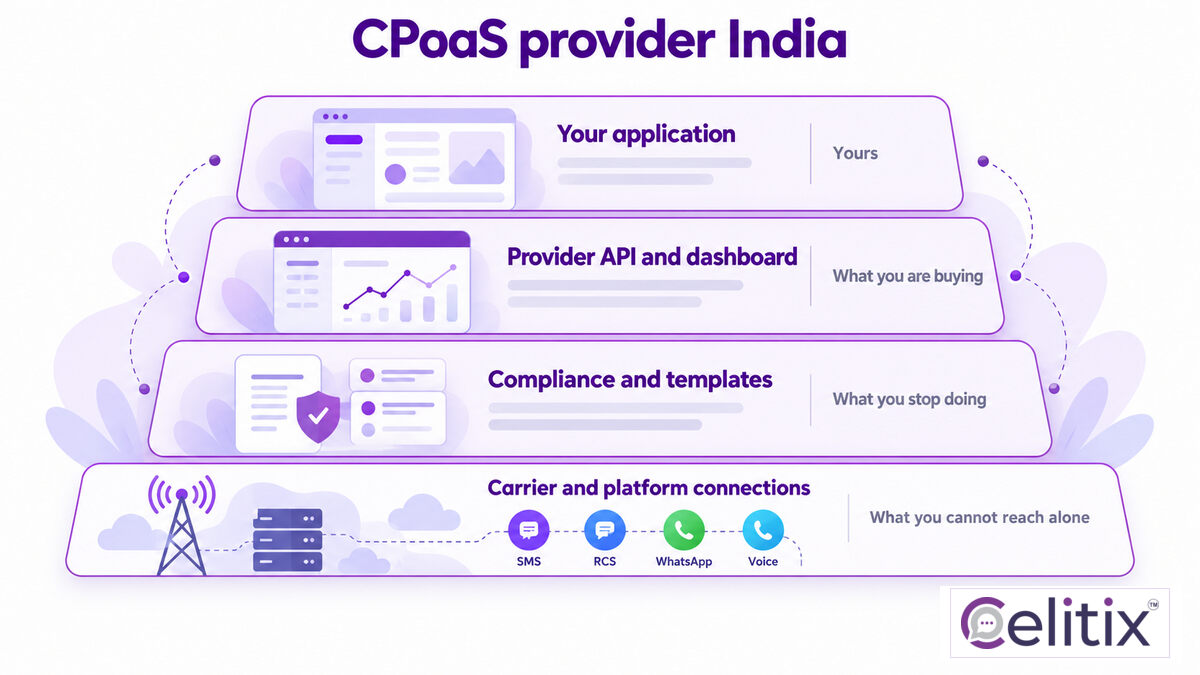
Table of Contents
What a CPaaS provider India actually sells you
Strip away the branding and a CPaaS provider India is selling three things: connections to carriers and platforms you cannot easily reach yourself, a layer that handles Indian compliance paperwork, and someone to call when delivery breaks.
You are not buying the ability to send a message. You are buying the ability to stop thinking about how a message gets sent.
That framing matters, because it tells you what to compare. The per message rate is the easiest thing to compare and the least likely to decide whether the relationship works.
CPaaS vs direct carrier api, the decision that comes first
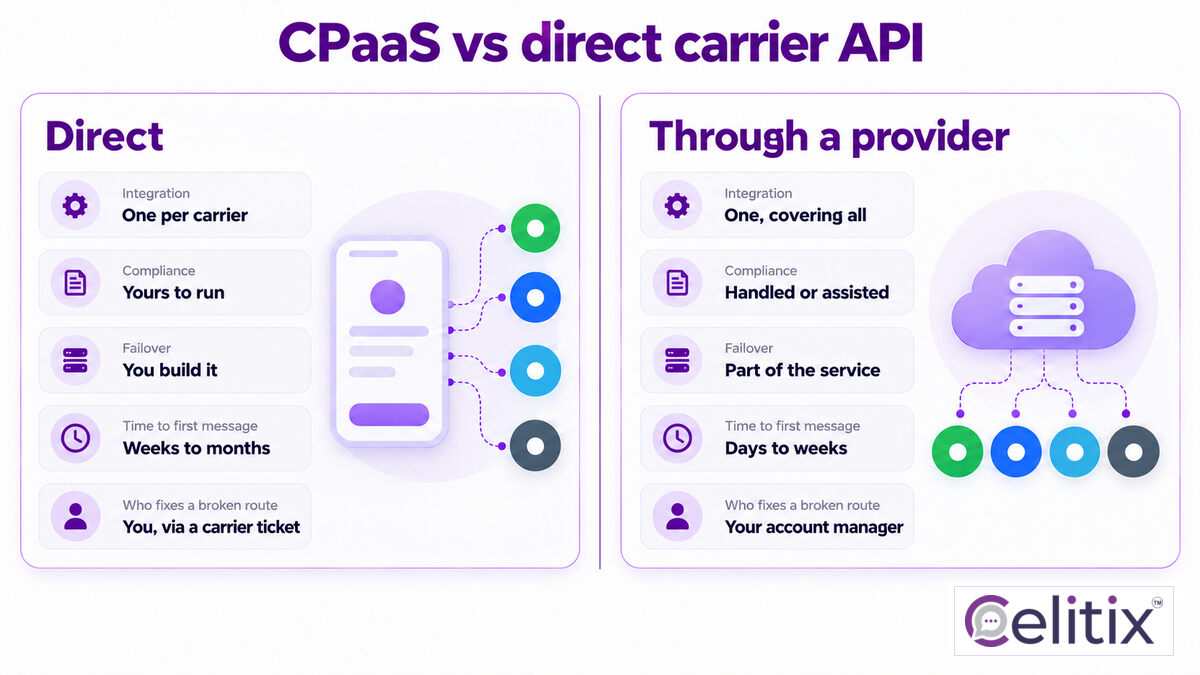
Before comparing any CPaaS provider India, settle whether you need one. Some businesses genuinely do not.
Consideration | Direct carrier or platform | Through a provider |
|---|---|---|
Integration effort | One per carrier or platform | One, covering all of them |
Compliance paperwork | Yours to run | Usually handled or assisted |
Failover between routes | You build it | Part of the service |
Time to first message | Weeks to months | Days to weeks |
Who fixes a broken route | You, through a carrier ticket | Your account manager |
Cost at very high volume | Can be lower | Includes a margin |
The honest version of CPaaS vs direct carrier api is this. At very high and very stable volume on one channel, direct can be cheaper. Across several channels, or where compliance work would land on a small team, a provider usually wins on total cost once you price your own engineering time.
CPaaS pricing comparison India, and where the real cost hides
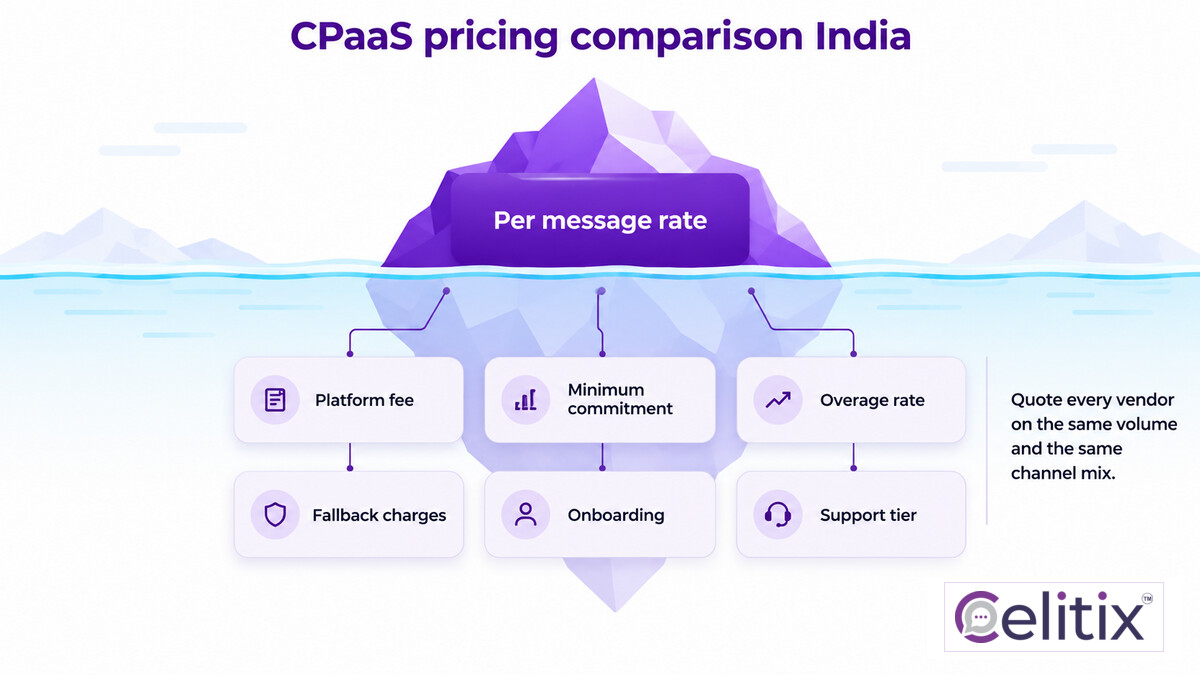
Most buyers compare the headline per message rate and stop. That is how two quotes that look identical produce invoices that differ by a third.
A CPaaS pricing comparison India is only meaningful once these are on the table for every vendor:
Platform or licence fee. A monthly charge independent of volume, which some providers quote and some bury.
Minimum commitment. The volume you pay for whether or not you send it.
Overage rate. What you pay above the committed tier, which is often well above the headline.
Fallback charges. On RCS especially, undelivered messages fall back to SMS and bill separately.
Onboarding and setup. Registration assistance is sometimes free, sometimes chargeable.
Support tier. Whether a human answering at two in the morning costs extra.
Ask every vendor to quote on the same assumed monthly volume and the same channel mix. Without that, you are not comparing anything.
Channel billing is not uniform
WhatsApp bills per conversation window. SMS and RCS bill per message. Voice bills per minute or per call. A provider who is cheapest on one channel is frequently not cheapest on another, so a single blended rate hides more than it tells you.
Seven questions to ask a CPaaS vendor
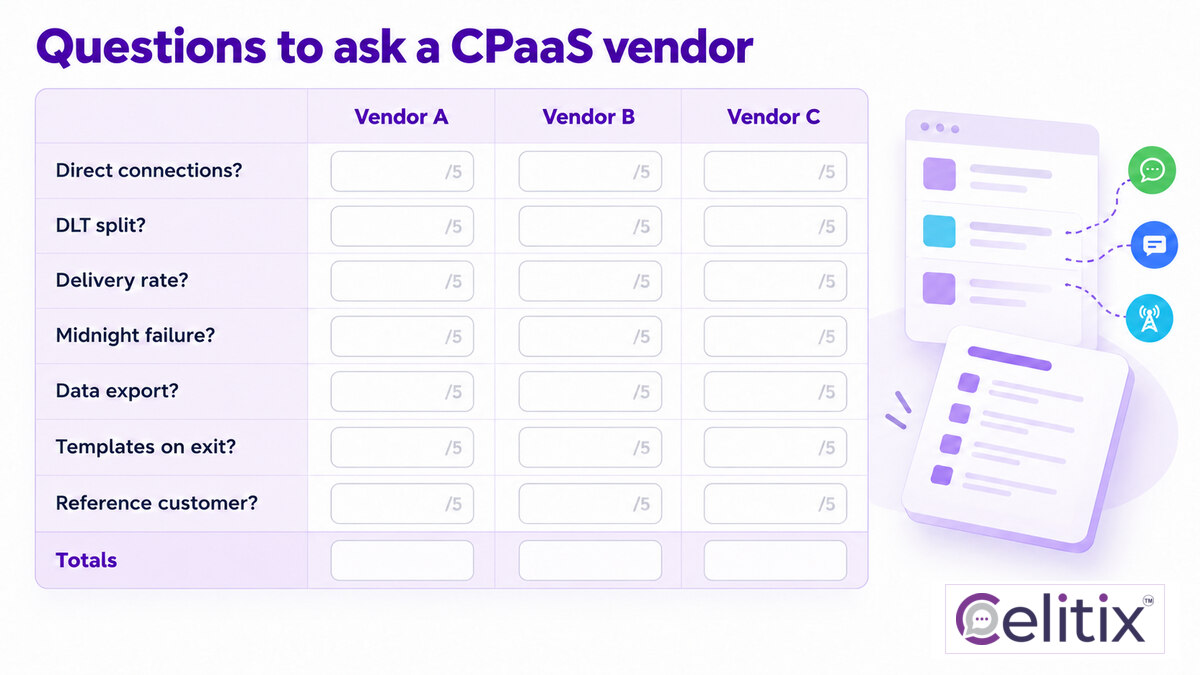
These are the questions to ask a CPaaS vendor that separate a real operation from a reseller with a dashboard. Ask all of them, of everyone.
Which carriers and platforms do you connect to directly, and which through an intermediary? More hops means more places for delivery to fail and more people to blame.
What part of DLT registration do you handle, and what stays with us? Chain binding and template submission are the two that matter.
What is your delivery rate on our kind of traffic, and how is it measured? Submitted is not delivered.
What happens when a route fails at midnight? Ask for the escalation path and the names on it.
Can we export our data and message logs, in what format, at what notice?
What happens to our registered templates and sender IDs if we leave?
Who else like us do you run, and will you put us in touch? A refusal here is itself an answer.
Score the answers rather than the pitch. Any CPaaS provider India can demonstrate a dashboard. Few can answer question four without hesitating.
CPaaS contract terms to check before signing
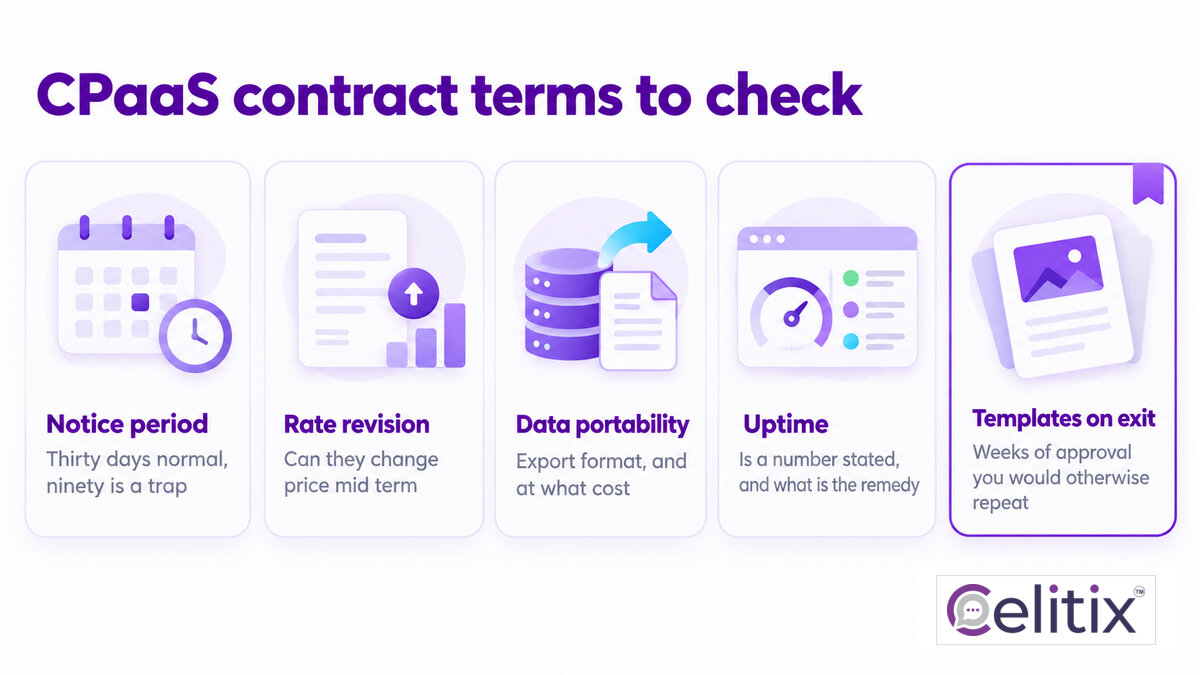
The commercial terms decide how expensive it is to be wrong. These are the CPaaS contract terms to check:
Term | What to look for |
|---|---|
Notice period | Thirty days is normal. Ninety days with auto renewal is a trap. |
Rate revision | Whether they can change pricing mid term, and with what notice |
Minimum commitment | Whether unused volume rolls forward or is simply lost |
Uptime commitment | Whether a number is stated, and what the remedy is if missed |
Data portability | Export format and whether it costs anything |
Template and sender ID transfer | What you can take with you on exit |
The last row is the one most buyers miss. Registered templates and approved sender IDs represent weeks of waiting. A contract that leaves them behind makes switching far more expensive than the rate card suggests.
When a CPaaS provider India is the wrong choice
Three situations where the answer is no, and an honest vendor will tell you so.
You send a few hundred messages a month. A free business app and a spreadsheet will do, and you will not recover the platform fee.
You have one channel, one very high volume use case, and an engineering team with capacity. Direct may be cheaper.
Your actual problem is that nobody answers customer messages. A platform does not fix staffing, and it will make the backlog more visible rather than smaller.
If your question is whether to automate rather than which platform to buy, chatbot against support agent is the more useful read first.
The regulatory context you are buying into
Whoever you pick, Indian messaging sits inside rules you remain responsible for. SMS and RCS run under TRAI and the DLT framework, set out in our DLT registration process India guide. WhatsApp runs under Meta's business messaging policy.
A provider can do the paperwork. A provider cannot absorb the liability. Any CPaaS provider India implying otherwise is overselling.
If you are still deciding which channels to run at all, omnichannel communication covers how they fit together, and comparing SMS services covers the SMS side specifically.
Common questions
How many vendors should I shortlist?
Three. Fewer gives you no leverage on a CPaaS pricing comparison India, more turns the evaluation into a project of its own.
Is the cheapest CPaaS provider India usually the right one?
Rarely. Delivery rate and escalation matter more at the point something breaks, and that is the point you will remember.
What is the single most useful of the questions to ask a CPaaS vendor?
What happens when a route fails at midnight. It is the one that cannot be answered from a slide.
Should I resolve CPaaS vs direct carrier api before shortlisting?
Yes. Comparing providers before deciding whether you need one wastes everyone's time, including yours.
Which of the CPaaS contract terms to check is most often missed?
What happens to registered templates and sender IDs on exit. They represent weeks of approval time you would otherwise repeat.
Where to start with Celitix
Celitix is one CPaaS provider India among several, and this guide is deliberately written so you can use it against us as easily as anyone else. Ask us all seven questions.
Our own answers, including where we are not the right fit, are set out in why choose Celitix as your CPaaS partner.
Put these questions to Celitix