DLT registration process India, the five stages and what each one costs

Table of Contents
Stage one, entity registration, and why one portal is enough
Templates, variables, and the DLT template rejection reasons that cost the most time
What the DLT registration process India actually is
Every commercial SMS sent to an Indian mobile number passes through a blockchain register run by the telecom operators under TRAI and its Telecom Commercial Communications Customer Preference Regulations. The DLT registration process India is how your business gets onto that register.
It is not a single form. It is five separate approvals, held by different parties, and three of them can run at the same time once the first one lands. Most of the delay people complain about comes from running all five in a line when they did not have to.
This guide is the operational reference for the DLT registration process India. If you want the shorter version of why DLT exists at all, that is covered in our introduction to DLT for SMS marketing.
The five stages, and which ones overlap
Stage one has to finish before anything else starts. Stages two, three and four can be worked in parallel. Stage five needs your provider at the other end.
Stage | What it registers | Depends on | Can run in parallel |
|---|---|---|---|
1. Entity | Your business as a Principal Entity | Nothing | No, this gates everything |
2. Header | The sender ID recipients see | Stage 1 | Yes, with 3 and 4 |
3. Template | The exact message wording | Stage 1 | Yes, with 2 and 4 |
4. CTA whitelist | URLs and phone numbers in your templates | Stage 1 | Yes, with 2 and 3 |
5. Chain binding | Your link to your SMS provider | Stage 1, and your provider | Yes, but needs their action |
Run them sequentially and you are looking at three to four weeks. Run two, three and four together and most businesses are live in ten to fifteen working days.
Stage one, entity registration, and why one portal is enough
You register as a Principal Entity on one operator's portal. The registration propagates to the others, so there is no need to repeat it five times. This is the single most common waste of time in the whole DLT registration process India.
The five operator portals are:
Jio - trueconnect.jio.com
Airtel - dltconnect.airtel.in
Vodafone Idea - vilpower.in
BSNL - ucc-bsnl.co.in
MTNL - ucc-mtnl.in
Pick the operator your business already has a relationship with, or the one your SMS provider recommends, because that provider will be doing the chain binding at stage five.
What you need in hand before you start
Business PAN, or the proprietor's PAN for a sole proprietorship
Certificate of Incorporation, partnership deed, or GST certificate
Aadhaar or another government photo ID for the authorised signatory
Company letterhead, for the authorisation letter
Email address and mobile number of the authorised person, both of which receive one time passwords
The email and mobile matter more than people expect. Use an address that will still be monitored in a year, because renewal notices and template actions go there.
The DLT header registration rules, in plain terms
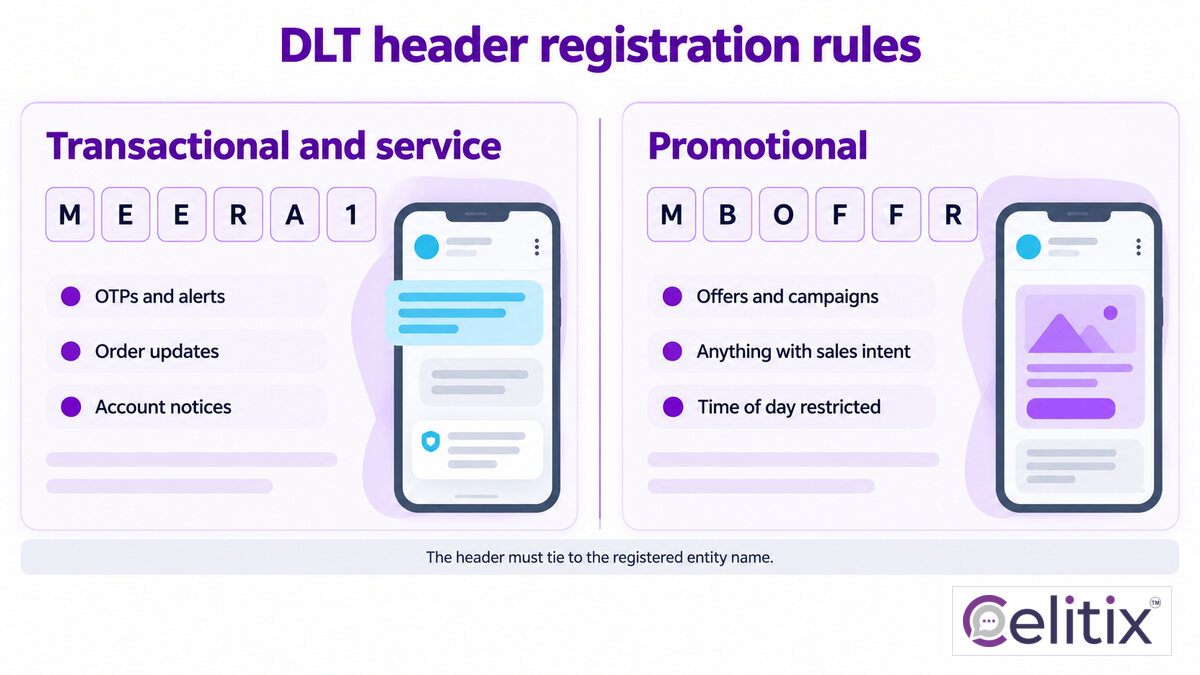
A header is the sender ID that appears instead of a phone number. Within the DLT registration process India, the DLT header registration rules split by what the message is for, and getting this wrong is a slow mistake because the header is printed on every message you ever send.
Header type | Used for | What operators ask for |
|---|---|---|
Transactional or service | OTPs, order updates, alerts, account notices | Proof the name belongs to you, often a trademark or a registration document |
Promotional | Offers, campaigns, anything with a sales intent | The same proof, plus the correct category on the entity record |
Two things trip people up here. The first is choosing a header that is a generic word rather than your brand, which operators reject because they cannot tie it to you. The second is applying for a header whose name does not match the registered entity name, which reads as impersonation.
If you do not hold a trademark, expect the header stage to take longer and to need a supporting document explaining the relationship between the name and the entity.
Templates, variables, and the DLT template rejection reasons that cost the most time
A template is the exact wording of a message, with the changeable parts marked as variables in the {#var#} form. Once approved, the template receives an ID, and what you actually send has to match it.
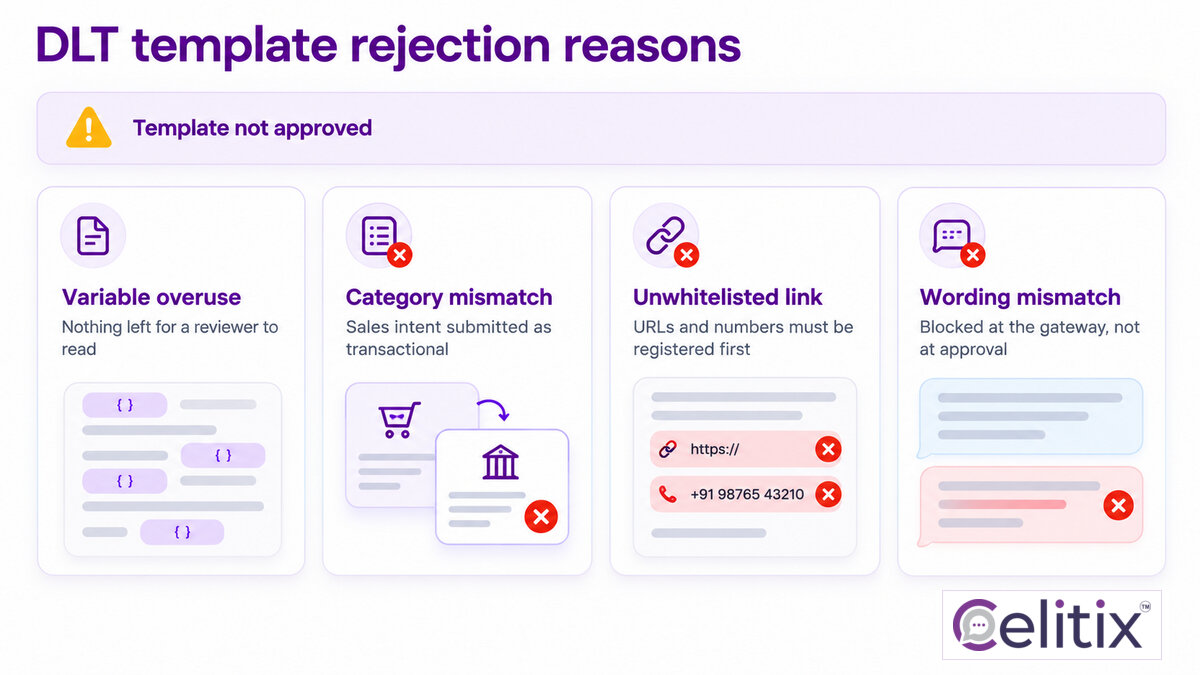
These are the DLT template rejection reasons that come up again and again at this point in the DLT registration process India:
Variable overuse. A template that is mostly variables carries no reviewable content, so it is read as an attempt to send anything under one approval.
Category mismatch. A message with any sales intent submitted under the transactional category. Operators read intent, not the label you picked.
Unwhitelisted links or numbers. Any URL or phone number in the body has to be whitelisted at stage four first, including shortened links.
Wording that does not match what you will send. Punctuation, line breaks and spacing count. Messages that differ from the approved template are blocked at the gateway, not at approval.
Write the template from a real message you have already sent, not from what you imagine sending. That one habit removes most rejections.
Stage four, CTA whitelisting, the step people forget
Every URL and every phone number inside a template has to be registered separately. Shortened links count, and so does a link that differs only by a tracking parameter.
Submit this alongside your templates rather than after. Otherwise templates come back refused for a reason that has nothing to do with their wording.
Stage five, chain binding, and why it needs your provider
Chain binding ties your Principal Entity to the Telemarketer Entity ID of whoever actually sends your messages. Without it, your approved templates exist but nobody is permitted to send them on your behalf.
You supply your provider's telemarketer ID on the portal, and they approve from their side. That approval usually comes back within a day or two, but it is a handoff, so start it early rather than treating it as the last step.
DLT charges and timelines India, and what to budget
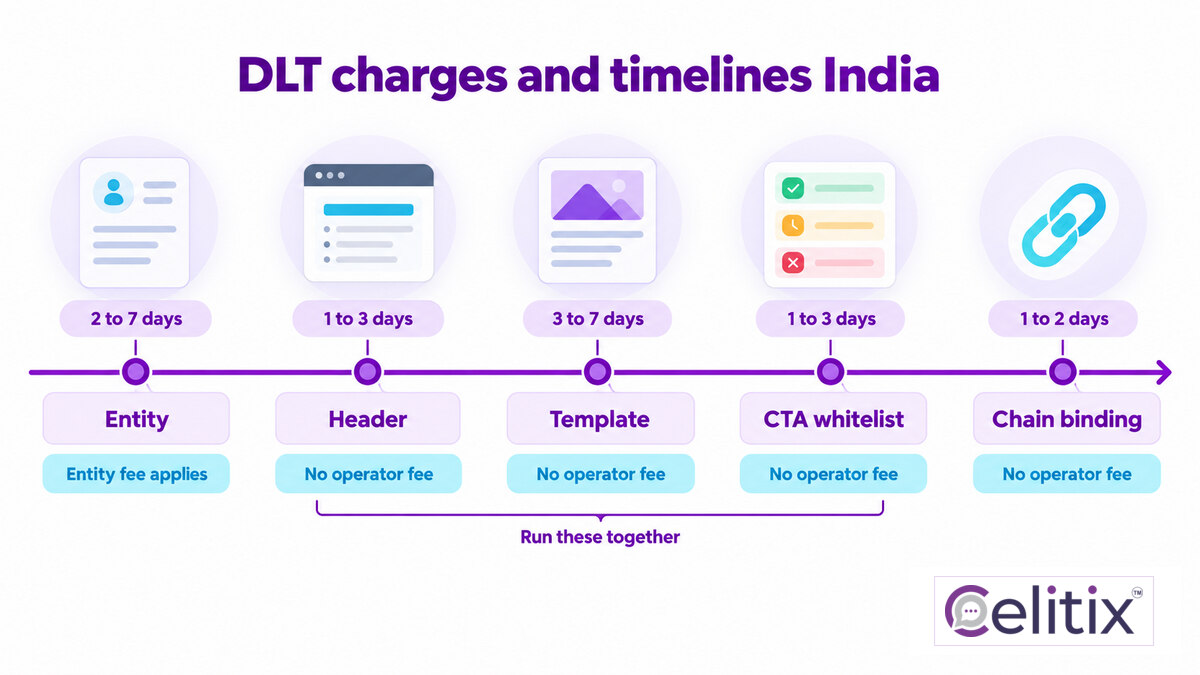
Across the DLT registration process India, entity registration is the only stage with a meaningful fee. Headers, templates, CTA whitelisting and chain binding are free at the operators.
Stage | Reported cost | Typical duration |
|---|---|---|
Entity registration | Around Rs 5,900 at the major operators, lower at BSNL | 2 to 7 working days |
Header registration | No operator fee | 1 to 3 working days with documents in order |
Template registration | No operator fee | 3 to 7 working days, longer in volume |
CTA whitelisting | No operator fee | 1 to 3 working days |
Chain binding | No operator fee | 1 to 2 days, depends on your provider |
Annual renewal | Varies by operator, some charge nothing | Diarise it, lapses stop sending |
A word of caution on those figures. The Rs 5,900 entity fee is reported consistently by Indian SMS providers, and BSNL lower, but operators revise fees without announcement.
Confirm the current amount on the portal before you put it in a budget.
The same applies to durations. These are the ranges providers publish from their own onboarding experience, not a TRAI service standard, so treat them as planning figures rather than commitments.
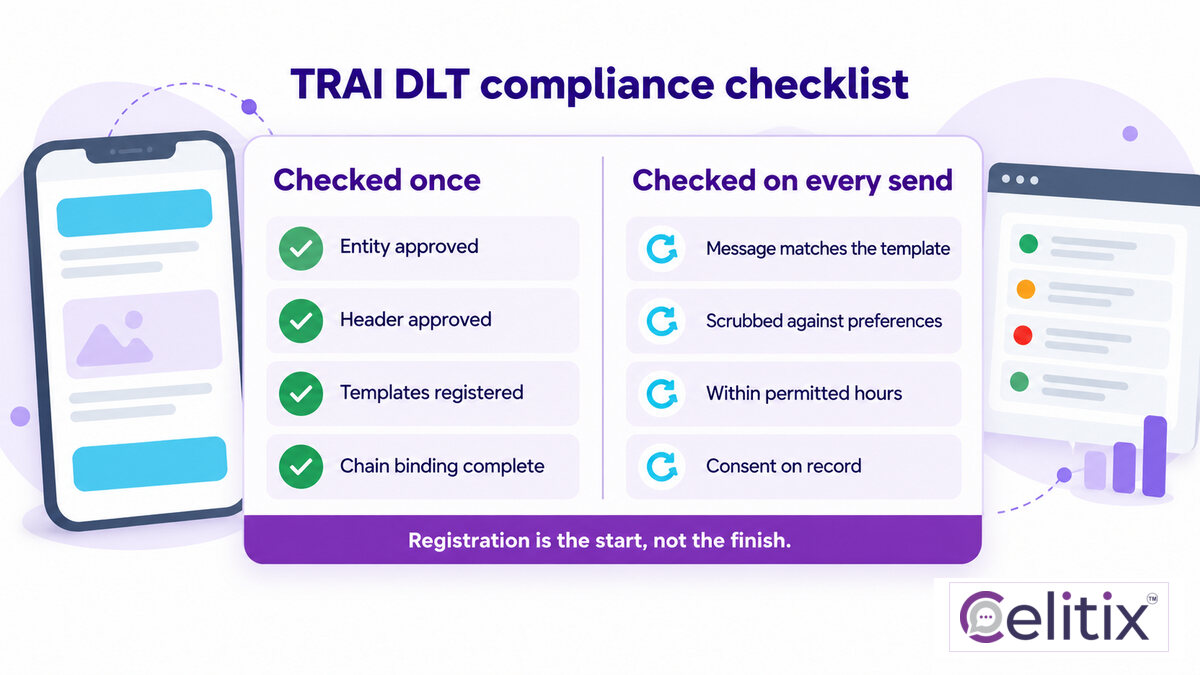
A TRAI DLT compliance checklist for after you go live
The DLT registration process India ends at go live, but your obligations do not. These obligations continue for as long as you send.
Every message must match an approved template exactly
Promotional messages are scrubbed against customer preference registrations before delivery
Promotional sending is restricted by time of day, so schedule accordingly
Consent records must exist for the numbers you message and must be producible
New message wording needs a new template, every time
Entity registration needs renewing before it lapses
Build the TRAI DLT compliance checklist into whoever runs your campaigns rather than leaving it with whoever did the registration. The two are rarely the same person six months later.
What happens when you ignore it
Mismatched messages fail silently at the gateway. You see delivery reports that look like network failures and spend a week blaming the operator. Repeated violations escalate to header suspension, which stops every message on that sender ID at once, including your OTPs.
How this connects to your other channels
DLT governs SMS. It does not govern WhatsApp, which runs on Meta's own template approval, covered in sending bulk WhatsApp messages legally. RCS sits in between, since the content rides Google's rails but Indian carriers still apply DLT template registration, which is covered in our RCS against SMS comparison.
If you are choosing a provider to handle any of this for you, how to compare SMS services sets out what to ask.
Common questions
Do I have to register on all five operator portals?
No. The DLT registration process India treats one entity registration as propagating to the others. Register once on the portal that suits you and your provider.
How long does the DLT registration process India take end to end?
Ten to fifteen working days is typical when stages two, three and four are run together. Run sequentially it stretches to three or four weeks.
Can I send a message that is not in an approved template?
No. It will be blocked at the gateway. The delivery report often looks like a network failure, which is why this is diagnosed late.
What are the most common DLT template rejection reasons?
Too many variables, wrong category for the intent, links or numbers that were never whitelisted, and wording that does not match what you intend to send.
Do the DLT charges and timelines India change?
Yes. Operators revise fees and run promotions. Check the portal before budgeting rather than relying on a figure published in a blog, including this one.
Where to start with Celitix
Celitix handles the parts of the DLT registration process India that sit with a provider, namely chain binding and template submission. That removes stages four and five from your side of the work.
If you want to judge that before committing, our evaluation checklist for a CPaaS partner sets out the questions to ask us and anyone else.
Talk to Celitix about DLT onboarding