WhatsApp AI agent, what it can actually do for an Indian business
Table of Contents
What separates a WhatsApp AI agent from a chatbot
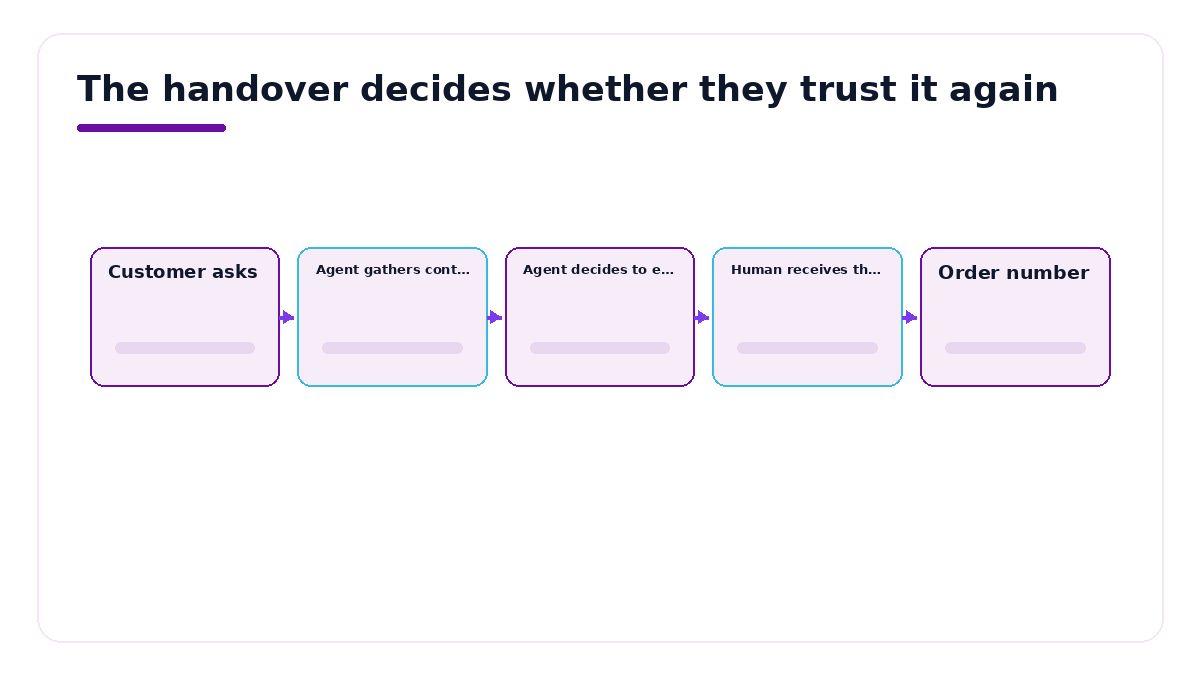
A chatbot follows a flow somebody drew. A WhatsApp AI agent decides what to do next, calls a system to find out, and keeps going until the task is finished or it decides a human is needed.
That difference is not about language quality. A well-written rule-based bot can sound perfectly natural. The difference is whether the path through the conversation was drawn in advance.
If you want the mechanics of the scripted kind, how AI chatbots on WhatsApp work covers it. This guide is about the agentic kind, and specifically about where it earns its cost and where it does not.
What a WhatsApp AI agent needs before it is useful
Three things, and a deployment missing any of them produces an expensive way to say "I did not understand that".
Tools. Real system access, so it can look up an order rather than ask for one
Boundaries. A written list of what it may decide and what it must escalate
A handover. A human who receives the thread with the context already gathered
The first is what most pilots skip. An ai agent for customer support with no system access is a search box over your help centre, and customers already have one of those.
Give it the order lookup, the shipment status, the ticket history and the ability to raise a request. The value is in the lookup, not the language.
Where an ai agent for customer support actually pays
On the queries that are repetitive, require a lookup, and currently take an agent two minutes each. That is a narrow definition and it is deliberate.
Query type | Agentic fit | Why |
|---|---|---|
Where is my order | Strong | One lookup, unambiguous answer |
Reschedule a delivery | Strong | Lookup plus a bounded write |
Change an address | Medium | Needs a validity check and a cutoff rule |
Explain a charge | Medium | Lookup plus judgement about tone |
Negotiate a refund | Weak | Commercial judgement, escalate |
Complaint about service | Weak | Needs a human early |
A WhatsApp AI agent that handles the first two well and hands the last two over quickly beats one that attempts everything. Coverage is the wrong target, because the cost of a bad answer is higher on chat than on a web page.
Measure containment on the queries you aimed at, not across all traffic. An agent resolving 70 per cent of delivery queries is a success even if overall containment looks modest.
How to keep an autonomous chat agent india customers trust
Say what it is. An autonomous chat agent india buyers encounter without warning generates complaints that a disclosed one does not, and disclosure costs nothing in completion rate.
Then make escalation trivially easy. One clear way to reach a person, available in every turn, not buried behind three failed attempts at understanding.
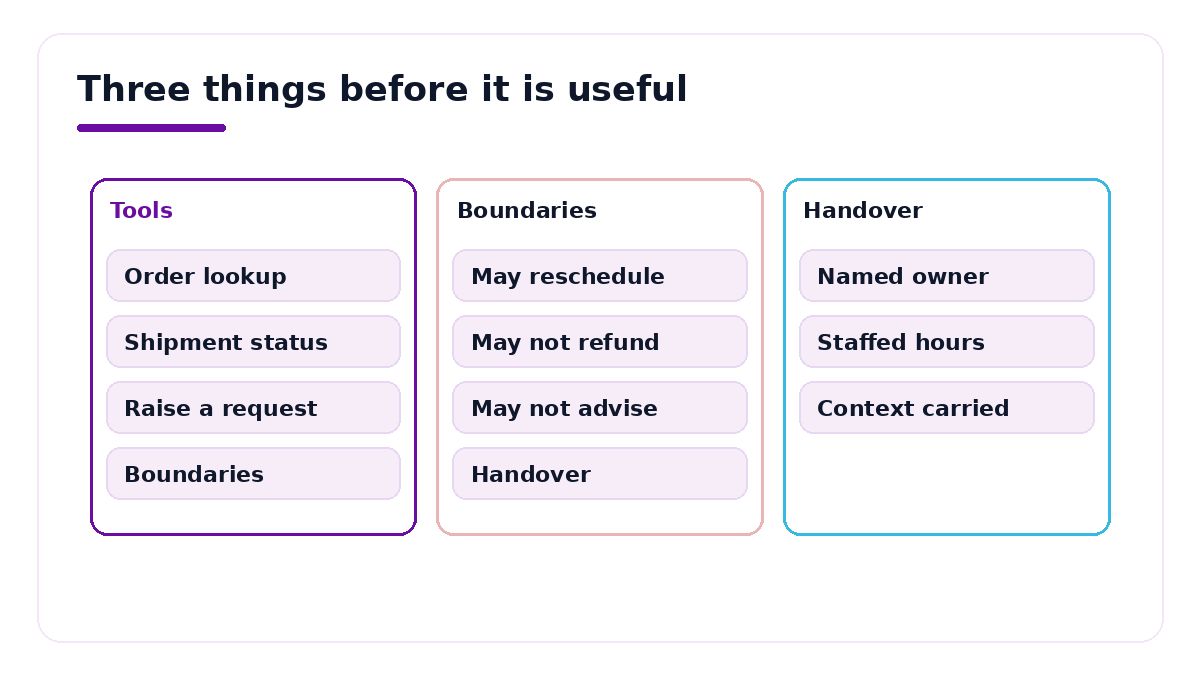
The handover is the part that decides whether people trust it again. A thread that reaches a human with the order number, the question and what has already been tried feels like progress. One that restarts feels like a wasted five minutes.
An autonomous chat agent india teams deploy should also know its own hours. Promising a human at 2am when nobody is staffed damages trust more than saying so plainly.
What it costs, counted properly
Four lines, and the model is rarely the biggest. Conversation charges to Meta, your platform margin, the model inference cost, and the engineering time to build and maintain the tool integrations.
The fourth is ongoing rather than one-off. Every change to an underlying system is a change the agent has to be taught, and an agent whose tools have drifted is worse than no agent.
Compare against cost per resolved query rather than per message, and include the escalated conversations in the denominator. An agent that resolves half and escalates half has not halved your cost, because the escalated half arrives with overhead.
WhatsApp API conversation pricing and pricing cover the first two lines. Chatbot vs support agent sets out the headcount arithmetic.
Where a WhatsApp AI agent should not be used
Anywhere a wrong answer carries real cost and cannot be reversed. That rules out more than vendors like to admit, and the exclusions are worth writing down before launch rather than discovering them.
Medical or legal guidance. Not a judgement to delegate to a probabilistic system
Financial commitments. Quotes, waivers and settlements need a human
Anything irreversible. Cancellations and deletions should confirm with a person
Distress. An upset customer needs a human immediately, not a better answer
Regulated disclosures. Where the exact wording is prescribed
Encode these as hard stops rather than instructions. An instruction is a suggestion to a model, while a tool it cannot call is a boundary it cannot cross.
How to run the first ninety days
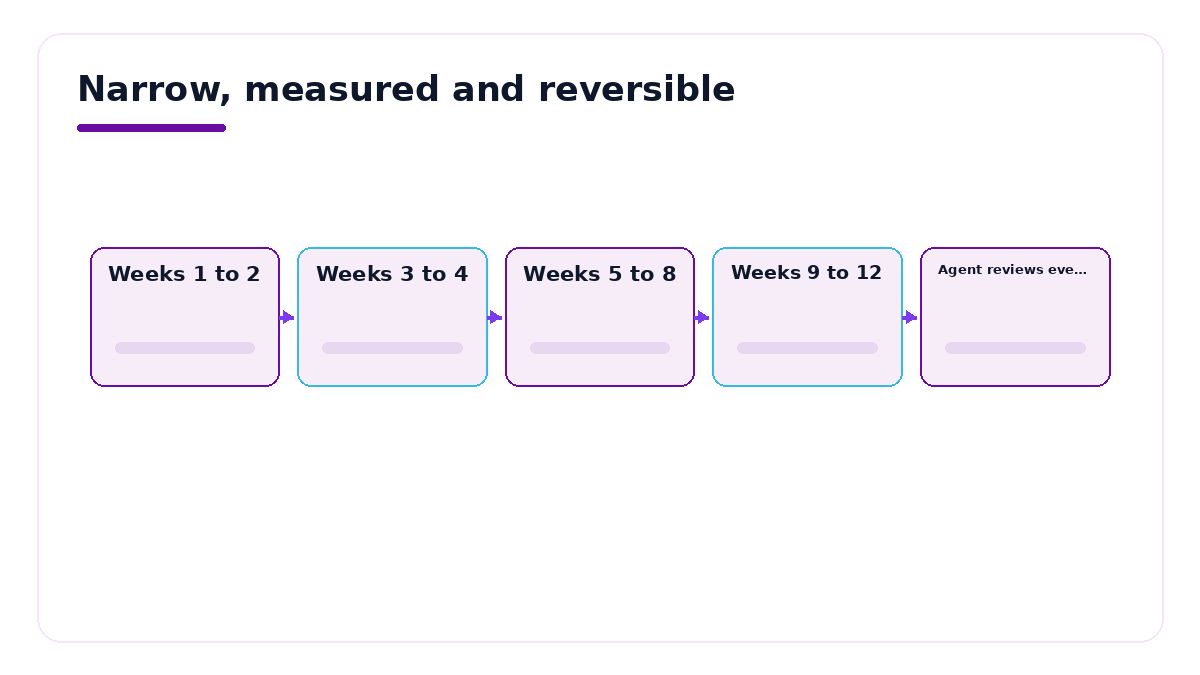
Narrow, measured and reversible. The common failure is launching broad, finding the quality uneven, and switching the whole thing off.
Weeks 1 to 2. One query type, agent reviews every answer before it sends
Weeks 3 to 4. Same query type, sending live, with daily review of transcripts
Weeks 5 to 8. Add the second query type only once the first holds
Weeks 9 to 12. Add the write actions, starting with the reversible ones
Read transcripts yourself during the first month. Dashboards show containment, but only transcripts show the three places where the WhatsApp AI agent sounded confident and was wrong.
The surrounding stack is WhatsApp chatbot, WhatsApp Business API, WhatsApp live chat and integrations for the tool access.
For routing and inbox design see live chat services and website live chat. Lead-side use cases are in lead generation chatbot and WhatsApp lead generation tool, and measurement in WhatsApp campaign analytics.
Meta sets out the platform rules that constrain any automated responder in its business messaging policy, which applies equally to scripted and agentic bots.
Where to start with Celitix
Pick your single highest-volume query and we will build a WhatsApp AI agent against it with the real system lookup wired in, the escalation path defined and the transcripts open to you from day one.
Start with one query typeCommon questions
What is the difference between a WhatsApp AI agent and a chatbot?
A chatbot follows a flow somebody drew in advance. An agent decides what to do next, calls a system to find out and continues until the task is done or a human is needed. The difference is the decision, not the language quality.
What does an AI agent need to be useful?
Real tool access so it can look up an order rather than ask for one, written boundaries on what it may decide, and a handover that gives a human the context already gathered. Without system access it is just a search box.
Where should an AI agent not be used?
Anywhere a wrong answer is costly and irreversible: medical or legal guidance, financial commitments, cancellations and deletions, distressed customers, and regulated disclosures. Encode these as tools it cannot call, not instructions.
How do you measure whether it is working?
Containment on the query types you aimed at, not across all traffic, plus cost per resolved query with escalated conversations in the denominator. Read transcripts during the first month, because dashboards hide confident wrong answers.
Should customers be told they are talking to an AI?
Yes. Disclosure costs nothing in completion rate and prevents the complaints an undisclosed agent generates. Pair it with an obvious way to reach a person in every turn, not one buried behind failed attempts.