RCS messaging use cases, which ones pay back and which disappoint
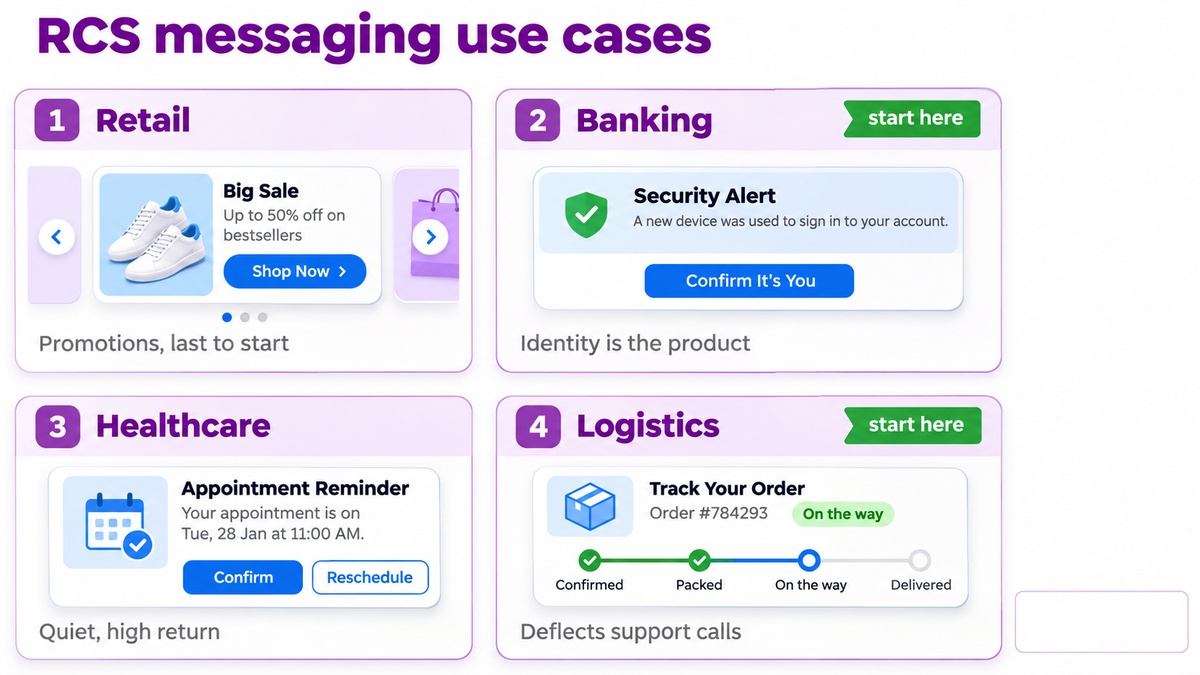
Table of Contents
The one thing that decides every one of the RCS messaging use cases
RCS for order tracking, the first of the RCS messaging use cases to try
How to read this guide
This is the informational half of RCS. If you want what it costs, how carrier approval works and what SMS fallback does to the maths, that is in our RCS business messaging India guide.
What follows is the use case side: which RCS messaging use cases actually earn their rate in India, and which look impressive in a demo and change nothing.

The one thing that decides every one of the RCS messaging use cases
Verified sender identity. Every other feature is secondary.
A customer sees your brand name, your logo and a verified tick instead of a six character header they do not recognise. For a bank, a hospital or a courier, that is the whole product. The rich cards and carousels are decoration on top of it.
So the RCS messaging use cases that pay back soonest are the ones where the customer currently ignores your message because they cannot tell it is you.
RCS for order tracking, the first of the RCS messaging use cases to try
The most common starting point, and the easiest to justify.
An SMS tracking update is a line of text and a shortened link nobody trusts. RCS for order tracking puts the product image, the order number and a progress bar in the message, with a button that opens live tracking.
Fewer where is my order calls, which is the number that actually pays for it
No shortened link, so no link that looks like a scam
A reschedule button turns a failed delivery into a rebooked one
Measure the support call volume on delivery questions before and after. That is the business case, not the open rate.
RCS for retail promotions, the last one to try
The demo favourite. A swipeable carousel of products with buy buttons, and it does look better than anything SMS can do.
It is also the use case we would start last. Promotional RCS costs more than transactional, promotional sending is time of day restricted in India, and a carousel sent to a cold list performs like any other message sent to a cold list.
Use it once transactional RCS is live and you know your fallback share. Of all RCS messaging use cases this is the one most likely to disappoint if it is first.

RCS for banking alerts
Where identity matters most, and the use case with the clearest regulatory logic behind it.
A transaction alert from a verified sender is distinguishable from a phishing SMS at a glance. That is worth more to a bank than any media feature, because the cost it avoids is fraud loss and the call centre volume that follows it.
Message | Send on RCS | Why |
|---|---|---|
Transaction alert | Yes | Identity is the point, and a report this button shortens fraud response |
Balance or statement ready | Yes, notify only | Say it is ready, never put the figure in the message |
Loan or card offer | Carefully | Promotional category, restricted hours, and it undermines the alert channel |
OTP | No | Keep OTPs on SMS, which has no fallback dependency |
The detailed treatment is in RCS messaging for banking.
RCS for appointment reminders
The quietest of the RCS messaging use cases and frequently the highest return, because a no show costs a clinic or a salon a whole slot.
A reminder card with confirm and reschedule buttons removes the phone call from both sides. The customer taps rather than ringing, and the slot gets refilled rather than wasted.
Keep clinical detail out of the message entirely, the same discipline set out in our WhatsApp for healthcare India guide. Date, time, place and practitioner is enough. Naming the department can disclose a condition to anyone who glances at the screen.
How the RCS messaging use cases compare on effort
Effort is not evenly spread, and the cheapest to launch is not always the one with the best return.
Use case | Build effort | What it needs from you |
|---|---|---|
Order tracking | Medium | A live tracking endpoint the button can open |
Transaction alerts | Low | The alert feed you already send over SMS |
Appointment reminders | Low | A booking system that accepts a reschedule |
Retail promotions | High | Product feed, images at spec, and a segmented list |
Transaction alerts and appointment reminders are the two you can launch on existing plumbing, which is a large part of why they come first.

The RCS messaging use cases we would not start with
Being straight about this saves a quarter.
Rich product discovery. A carousel is not a storefront. Customers browse on your site
Customer support threads. RCS supports replies, but a support team needs a shared inbox, not a message channel. See omnichannel communication
Anything needing guaranteed reach. RCS falls back to SMS, so a campaign that must land identically for everyone should just be SMS
OTPs. No upside, and a fallback dependency on the one message that must never be late
Choosing your first RCS messaging use case
Three questions, answered from your own data rather than a vendor deck.
Which message do customers ignore because they cannot tell it is you? That one gains most from a verified sender
Which message generates inbound calls? Deflecting those is the measurable saving
What share of your list is on a capable handset? Run one campaign and count the fallback before committing to volume
In most Indian businesses the answer to the first two is the same message, and it is almost always an order or a transaction update. Which is why the RCS messaging use cases that work are rarely the ones in the brochure.
Where DLT still applies
Indian carriers require DLT template registration for RCS traffic, exactly as for SMS. Entity registration gates it, and the full process is in our DLT registration process India guide. Google documents the underlying brand requirements in its brand verification guide.

Common questions
Which RCS messaging use cases should a retailer start with?
Order tracking, not promotions. It deflects support calls, bills at the transactional rate, and has no time of day restriction.
Is RCS for banking alerts better than SMS?
For identity, yes, because the verified sender is visible. Keep OTPs on SMS, where there is no fallback dependency.
Does RCS for appointment reminders need a clinical detail?
No, and it should not have one. Date, time, place and practitioner. Naming the department can disclose a condition.
Why not start with RCS for retail promotions?
Higher rate, restricted sending hours, and a carousel to a cold list performs like any message to a cold list. Start transactional.
Do these RCS messaging use cases need DLT?
Yes. Indian carriers apply DLT template registration to RCS as well as SMS, and entity registration has to be in place first.
Where to start with Celitix
Celitix registers the brand across Jio, Airtel and Vi and handles template submission, so you can test one of the RCS messaging use cases above on real traffic before committing to a volume contract.
Before committing to any provider, our buyer's guide sets out what to get in writing.
Ask Celitix to scope one RCS use case