DPDP Act messaging, consent, notice and deletion for customer communication
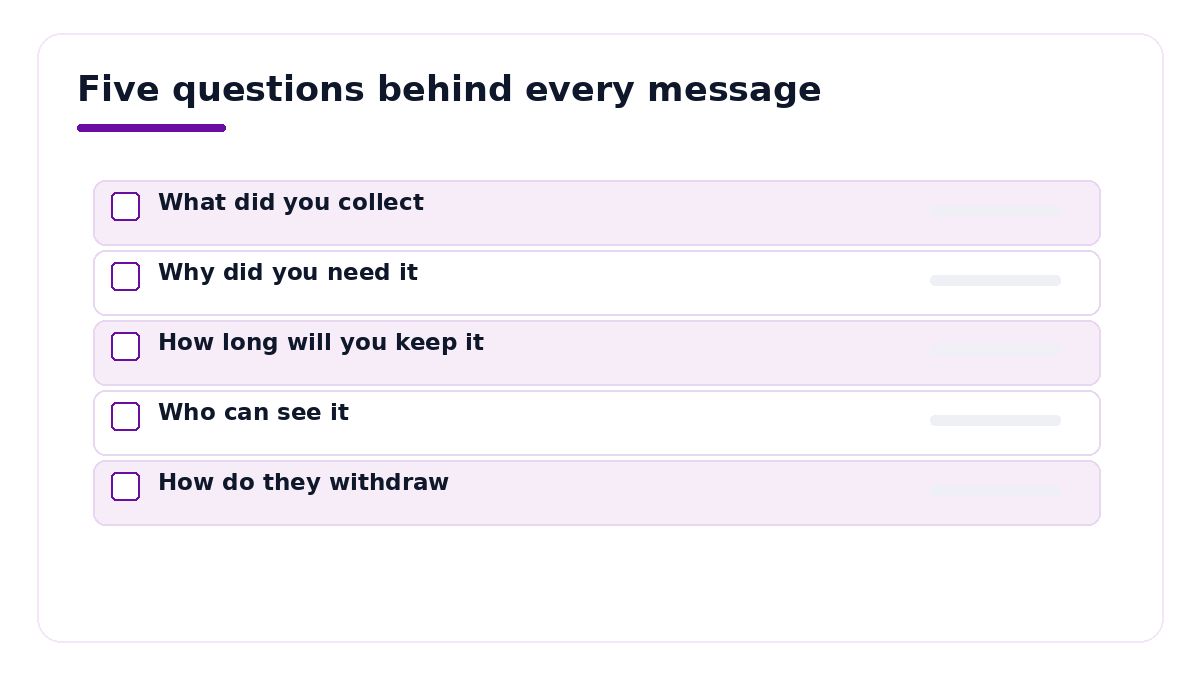
Table of Contents
Purpose limitation, the DPDP Act messaging rule most campaigns breach
Retention, deletion and the request you will eventually receive
Why DPDP Act messaging is a different question from consent
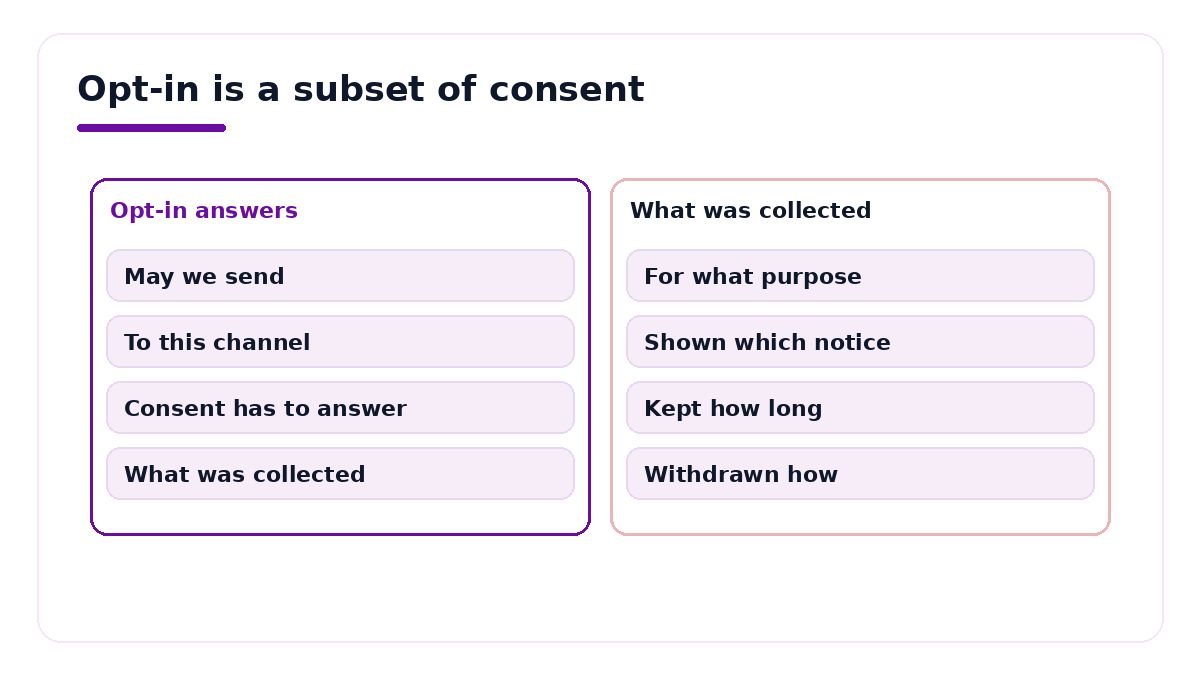
Indian businesses have handled messaging consent for years through DLT and WhatsApp opt-in. DPDP Act messaging asks something broader, which is whether you can account for the personal data behind the message at all.
Opt-in answers whether you may send. The Act asks what you collected, why, how long you will keep it, who can see it and what happens when somebody asks you to stop.
This guide is written for the person who has to answer those questions, not for a legal team. It is not legal advice, and where an obligation is genuinely contested this guide says so rather than inventing certainty.
Consent under the dpdp act, and how it differs from opt-in
Consent under the dpdp act has to be free, specific, informed, unconditional and unambiguous, given by a clear affirmative action. A pre-ticked box is not consent, and neither is a consent bundled into terms the customer had to accept anyway.
The practical gap for messaging teams is specificity. A single consent covering "communication" does not obviously cover a marketing broadcast two years later from a different brand in the same group.
What you have | What DPDP Act messaging expects | Usual gap |
|---|---|---|
WhatsApp opt-in flag | Consent record with purpose | No stated purpose |
DLT registration | Separate obligation, still required | Treated as sufficient |
Checkbox at signup | Specific and unbundled | Bundled into terms |
Timestamp | Plus the notice shown at the time | Notice text not retained |
Opt-out link | Withdrawal as easy as giving | Harder to leave than to join |
The last row is the one most messaging stacks fail. Consent under the dpdp act must be as easy to withdraw as it was to give, which means a reply keyword or a one-tap action, not an email to support.
Retain the notice text itself, not just the fact of consent. Proving what somebody agreed to requires showing what they were told.
What notice has to say before a DPDP Act messaging send
The notice is the statement given at the point of collection. It has to be plain, available in English and the Eighth Schedule languages, and specific about purpose.
What you are collecting. The number, and anything collected alongside it
Why. A stated purpose, decided before collection rather than after
How to withdraw. And that withdrawal is as easy as consent was
How to complain. The grievance route, and to the Board
For a messaging team the operational consequence is that the notice text becomes a versioned asset. When you change it, you need to know which contacts consented under which version.
That is a data model question more than a legal one, and it is far cheaper to build at the start than to reconstruct from logs afterwards.
Purpose limitation, the DPDP Act messaging rule most campaigns breach
A number collected to deliver an order is not a marketing list. This is the principle businesses breach most casually, usually without any intent to, because the data was already sitting in the same table.
DPDP Act messaging makes the question concrete: for each campaign, which stated purpose authorises this send. If the answer requires reinterpreting a purpose written for something else, the campaign needs fresh consent.
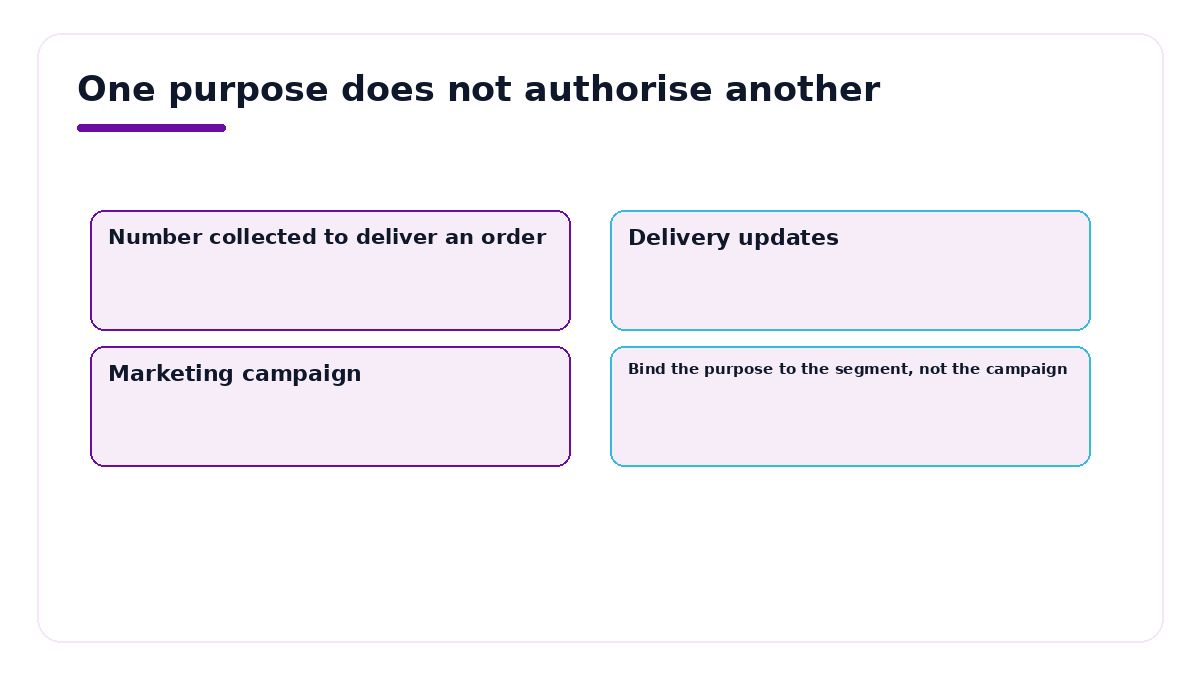
Build purpose into the segment, not into the campaign brief. A segment that carries its authorising purpose cannot accidentally be used for something it does not cover.
Celitix customers usually find this is the single change that takes longest, because it touches how lists are built rather than how messages are sent.
Retention, deletion and the request you will eventually receive
DPDP Act messaging and data protection rules india now expect a retention period you set and actually enforce, rather than keeping everything indefinitely because storage is cheap.
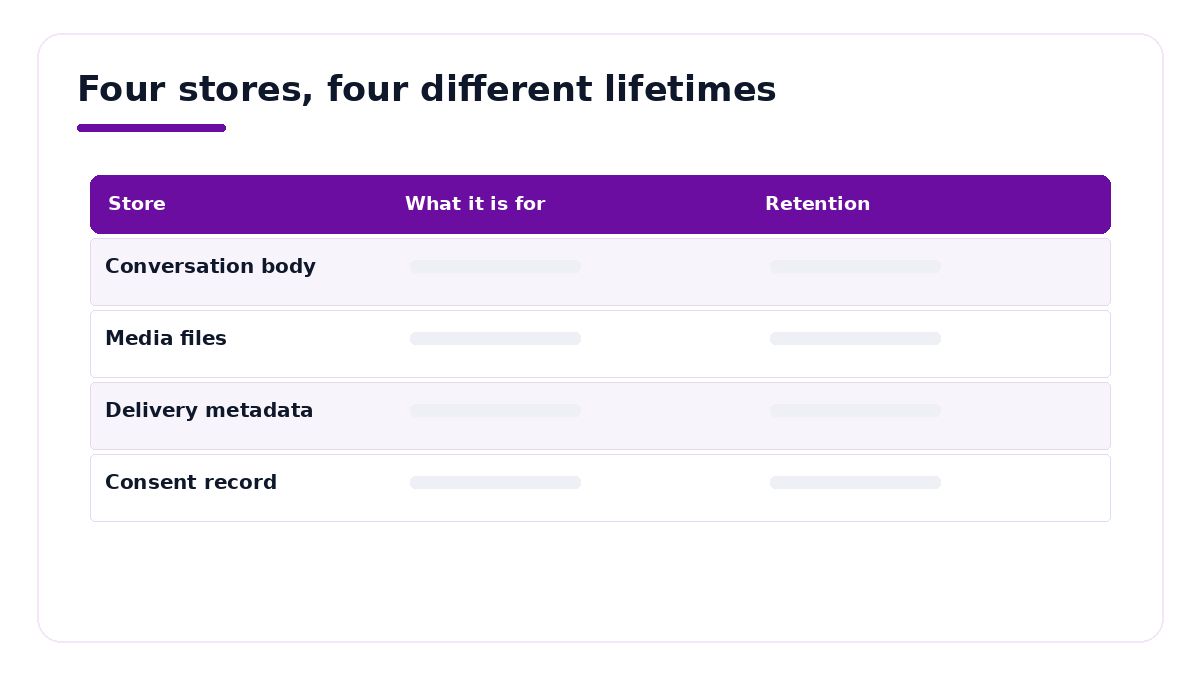
Messaging generates three separate stores with different sensible lifetimes: the conversation body, the media sent inside it, and the delivery metadata. Treating them as one thing produces either over-retention or lost audit trail.
Store | Typical purpose | Question to settle |
|---|---|---|
Conversation body | Service history and disputes | How long after the case closes |
Media files | Evidence, documents | Often the largest and least reviewed |
Delivery metadata | Billing and audit | Keep longer, but strip identifiers |
Consent record | Proof of lawful basis | Keep for as long as you rely on it |
Then test deletion. A retention policy nobody has executed is a document, not a control, and the first time you run it should not be in response to a request.
Ask your provider what deletion means on their side, whether it reaches backups, and on what timetable. Data protection rules india apply to the processor as well as to you, and the contract is where that is allocated.
What to put in your provider contract
DPDP Act messaging obligations do not transfer to a provider, but the provider has to support you in meeting them. Five clauses carry most of the weight.
Purpose binding. The provider processes only on your documented instructions
Retention and deletion. Periods, what deletion covers, and whether backups are included
Access control. Named roles, with an access log you can request
Breach notification. A timetable in hours, not a best-efforts sentence
Exit. Export format and a deletion certificate on termination
Ask for an access log sample during evaluation. A provider who can produce one in a demo has built the capability, and one who promises it for later usually has not.
The Ministry of Electronics and Information Technology publishes the framework and subsequent rules on its official site, and the detail has continued to develop, so check the current position rather than relying on a summary.
A practical order of work
Most teams try to fix everything at once and stall. This order front-loads the items that reduce exposure fastest.
Map what you hold. Numbers, conversations, media and metadata, per system
Write purposes down. One per collection point, before touching anything else
Fix withdrawal. Make leaving as easy as joining, which is quick and visible
Version the notice. And record which contacts saw which version
Set retention. Per store, then actually run a deletion cycle
Bind segments to purposes. So campaigns cannot borrow the wrong list
Fix the contract. Provider clauses, access logs and breach timetable
Related material: CPaaS solutions, SMS marketing, WhatsApp Business API and sending bulk WhatsApp messages legally.
For the SMS side of consent see the DLT registration guide and the DLT registration process. For privacy in voice, number masking service India and privacy protected calling India cover the same principles applied to calls.
Reporting and retention settings sit in WhatsApp campaign analytics and integrations.
Where to start with Celitix
Celitix will give you the retention settings, the deletion timetable and an access log sample in writing, which is what an enquiry actually asks for, before you commit to anything.
Ask Celitix for the retention settingsCommon questions
Does WhatsApp opt-in satisfy the DPDP Act?
No. Opt-in answers whether you may send. The Act asks what you collected, why, how long you keep it, who can see it and how somebody withdraws, and expects consent to be specific and unbundled rather than a general permission.
Is DLT registration enough for compliance?
No, and the two are separate obligations. DLT governs commercial SMS and remains required. The DPDP framework governs the personal data behind the message, which includes numbers, conversation content and media.
What is the most common breach in messaging?
Purpose limitation. A number collected to deliver an order gets used for a marketing campaign because the data was in the same table. Bind the authorising purpose to the segment so a campaign cannot borrow the wrong list.
How long should we keep conversation history?
There is no single answer, but you must set a period and enforce it. Treat the conversation body, the media and the delivery metadata as three stores with different lifetimes, and test the deletion cycle before you need it.
What should the provider contract say?
Purpose binding to your documented instructions, retention and deletion including whether backups are covered, named access roles with a log, a breach notification timetable in hours, and an export format plus deletion certificate on exit.