Privacy protected calling india, the four questions you will be asked
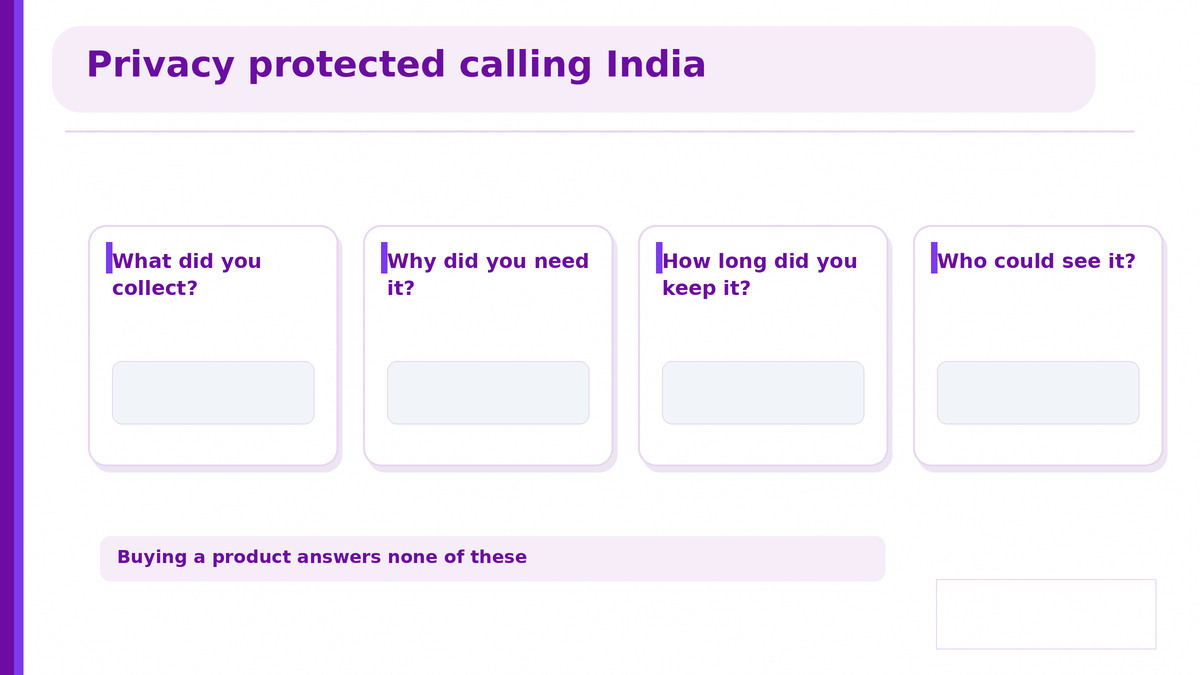
Table of Contents
Privacy protected calling india turns on four questions, not the technology
Dpdp act and call privacy, mapped onto privacy protected calling india
Anonymous calling for business india, where it is not optional
Caller identity protection india, and the limits of privacy protected calling india
What to put in writing about privacy protected calling india
Privacy protected calling india turns on four questions, not the technology
The operational side of masking is in the number masking service India guide and the engineering side in call masking solution. This post is for whoever has to answer a legal team or a regulator, and those four questions are always the same.
What did you collect? Numbers, recordings, call metadata, location
Why did you need it? A stated purpose, decided before collection, not after
How long did you keep it? A period you set and actually enforce
Who could see it? Named roles, with access logged
Buying a masking product answers none of those. It is a control that helps you answer the second and fourth well, and privacy protected calling india is the design posture rather than the purchase.
Dpdp act and call privacy, mapped onto privacy protected calling india
India's data protection framework, published by the Ministry of Electronics and Information Technology, rests on principles that translate directly into call handling decisions. I am not a lawyer and this is not legal advice, but the mapping is not controversial.
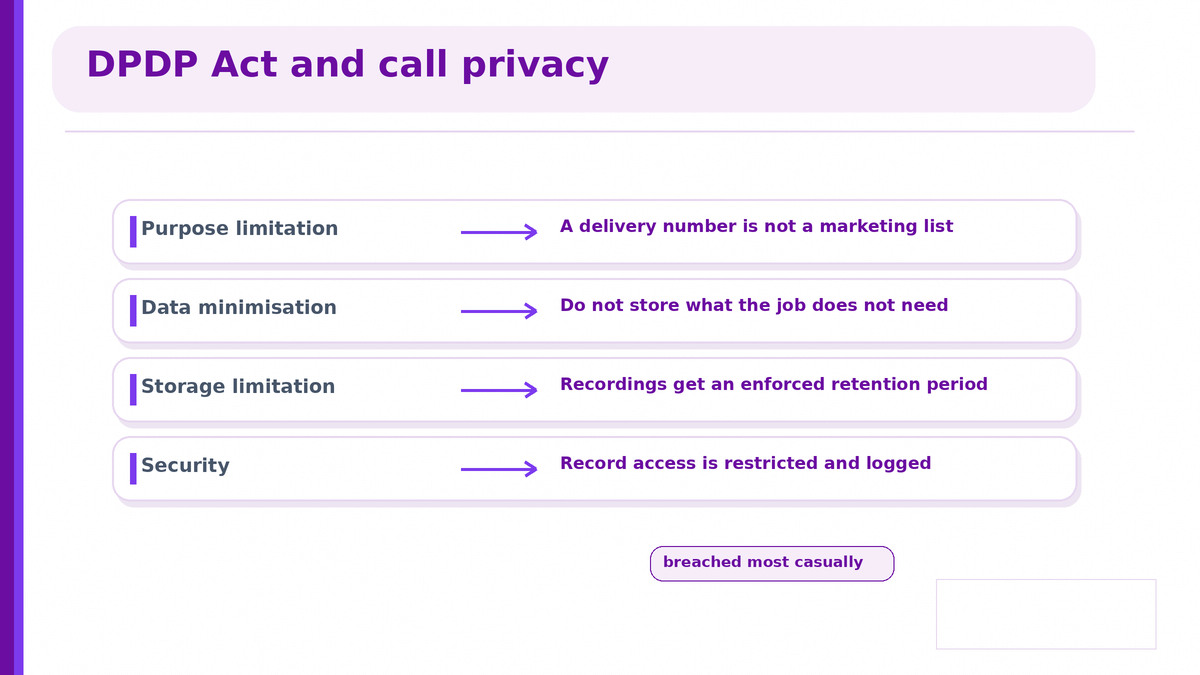
Principle | What it means for calls |
|---|---|
Purpose limitation | A number collected to complete a delivery is not a marketing list |
Data minimisation | If the job does not need the real number stored, do not store it |
Storage limitation | Recordings and bindings get a retention period that is enforced |
Security | Access to call records is restricted and logged |
Purpose limitation is the principle businesses breach most casually, and it is where privacy protected calling india is won or lost. A platform that collects customer numbers to connect a delivery and later markets to them has used the data for a purpose nobody agreed to, and masking does not cure that because the platform held the number all along.
Recording needs its own decision
If you record masked calls, disclose it at the start of the call to both parties, set a retention period you can defend, and restrict who can play a recording. Recording quietly because the platform offers it is the most common avoidable failure in privacy protected calling india.
Anonymous calling for business india, where it is not optional
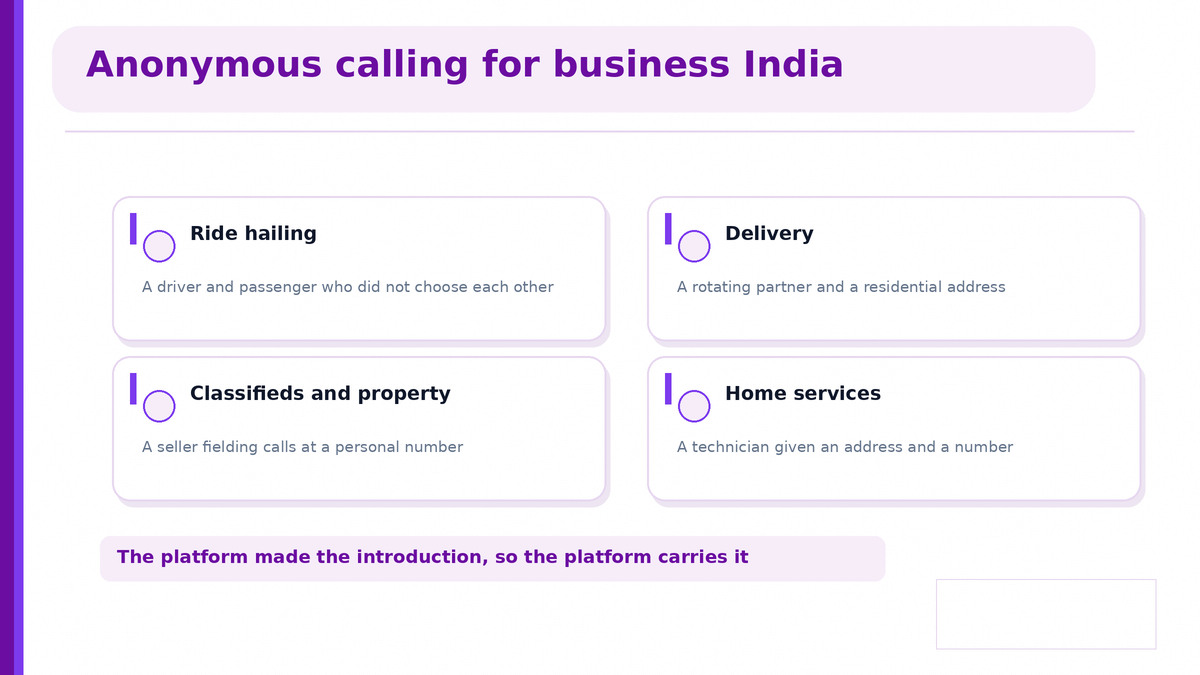
The duty attaches the moment your platform introduces two strangers and expects them to speak. At that point you chose to create the contact, so you carry the consequences of it.
Ride hailing. A driver and a passenger who did not choose each other
Delivery. A rotating partner and a residential address
Classifieds and property. A seller fielding calls from strangers at their personal number
Home services. A technician given a home address and a phone number
In each case the parties cannot protect themselves, because the platform made the introduction. That is why anonymous calling for business india is better understood as a duty of the intermediary than as a product feature.
Caller identity protection india, and the limits of privacy protected calling india
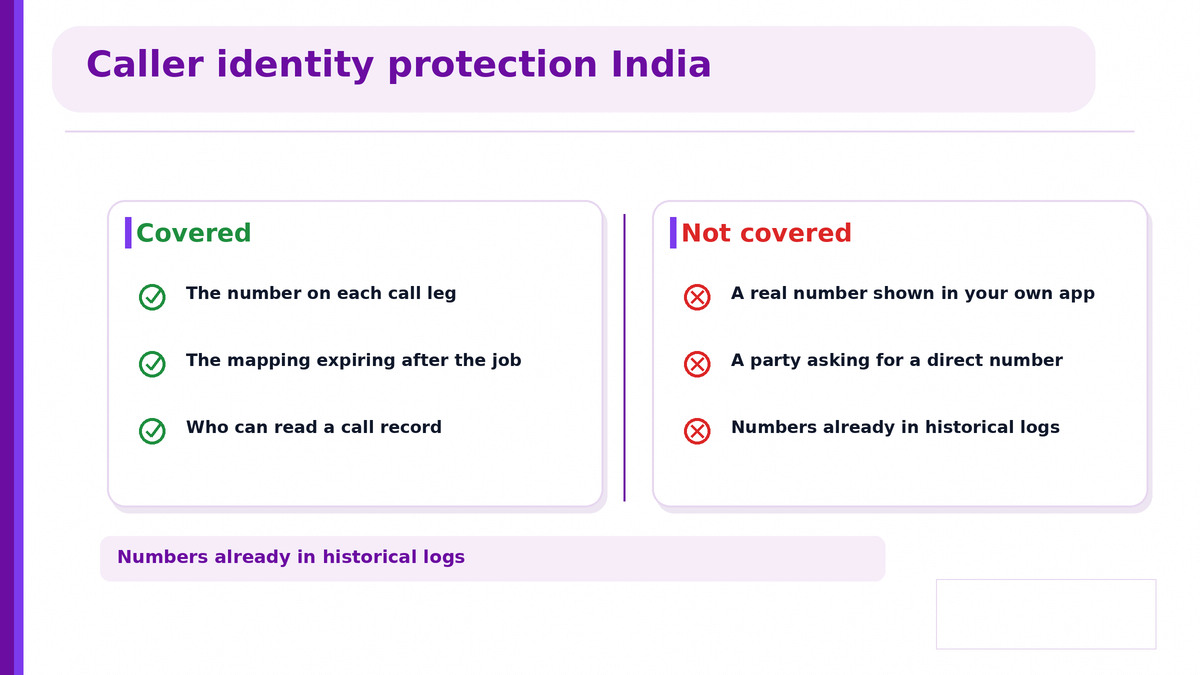
Worth being honest about what this does not cover, because overstating it is how businesses end up exposed while believing they are protected.
Covered | Not covered |
|---|---|
The number shown on each call leg | A real number displayed in your own app |
The mapping expiring after the job | A party asking for a direct number on the call |
Who can read a call record | Numbers already sitting in historical logs |
The right column is the work. Masking from today does nothing about eighteen months of real numbers in your partner app logs, and a masked call path in front of an app that shows the real number on a screen is decorative.
Audit where real numbers appear across your own surfaces first
Set a policy on direct contact requests, and spot check it
Decide what to do about historical data, which usually means deleting it
Do the audit before buying anything. It is the step that tells you whether a purchase will actually change your exposure.
Privacy calling for cab aggregators, and why it spread
This is where the pattern started, because the harm was most visible and most reported. The design that emerged is now the default everywhere.
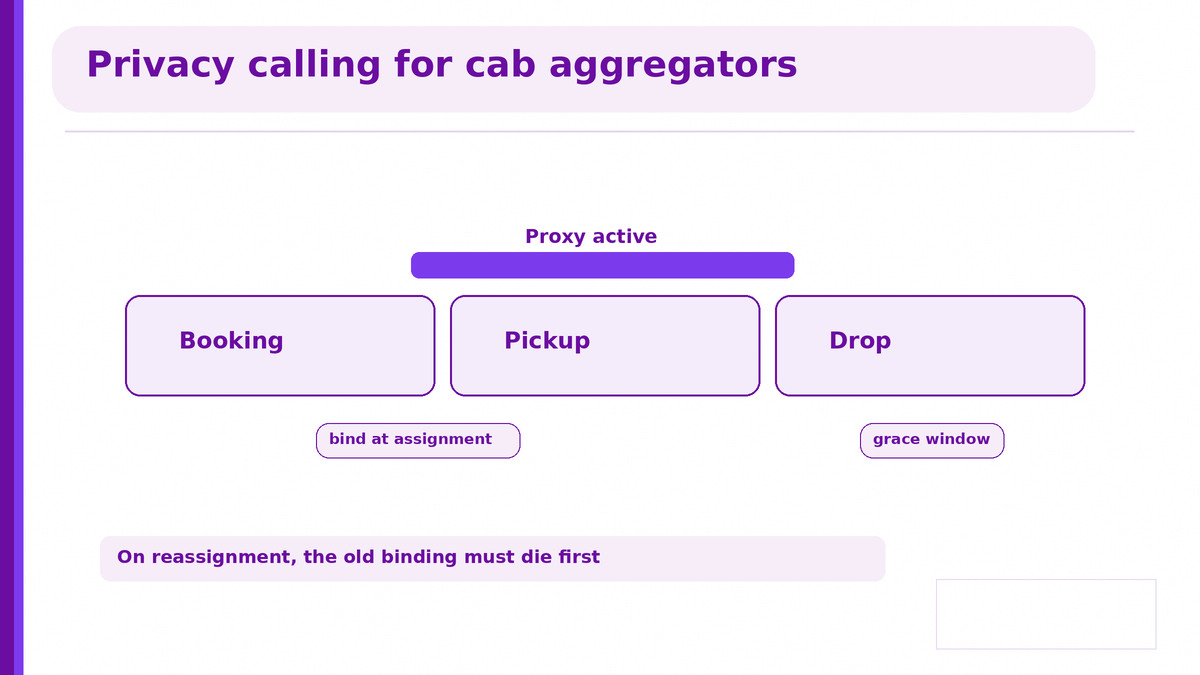
Bind at assignment, not at booking, because the partner is not known until then
Scope to the trip, so the channel exists only while the job does
Release at completion, with a short grace window for genuine callbacks
Kill the old binding on reassignment, which is the failure that produces a stranger calling at 10pm
The fourth is the one implementations get wrong, and it is worth testing specifically rather than assuming. Reassign a live job and confirm the previous partner can no longer reach the customer.
What to put in writing about privacy protected calling india
The stated purpose for every number and recording you hold
The retention period, and evidence that deletion happens
The number reuse interval before a released proxy is reissued
Who may access call records, and the access log
Your recording disclosure wording, and when in the call it plays
Those five are what an enquiry asks for. A business that can produce them has a defensible position on privacy protected calling india whether it built the masking or bought it.
Common questions
Does buying a masking product make us compliant?
How does the dpdp act and call privacy connect?
When is anonymous calling for business india not optional?
What does caller identity protection india not cover?
What did privacy calling for cab aggregators establish?
Where to start with Celitix
Celitix will give you the retention settings, the reuse interval and the access log in writing, which is what an enquiry actually asks for.
Ask Celitix for the retention settings