Call masking solution, build against buy and the parts that break
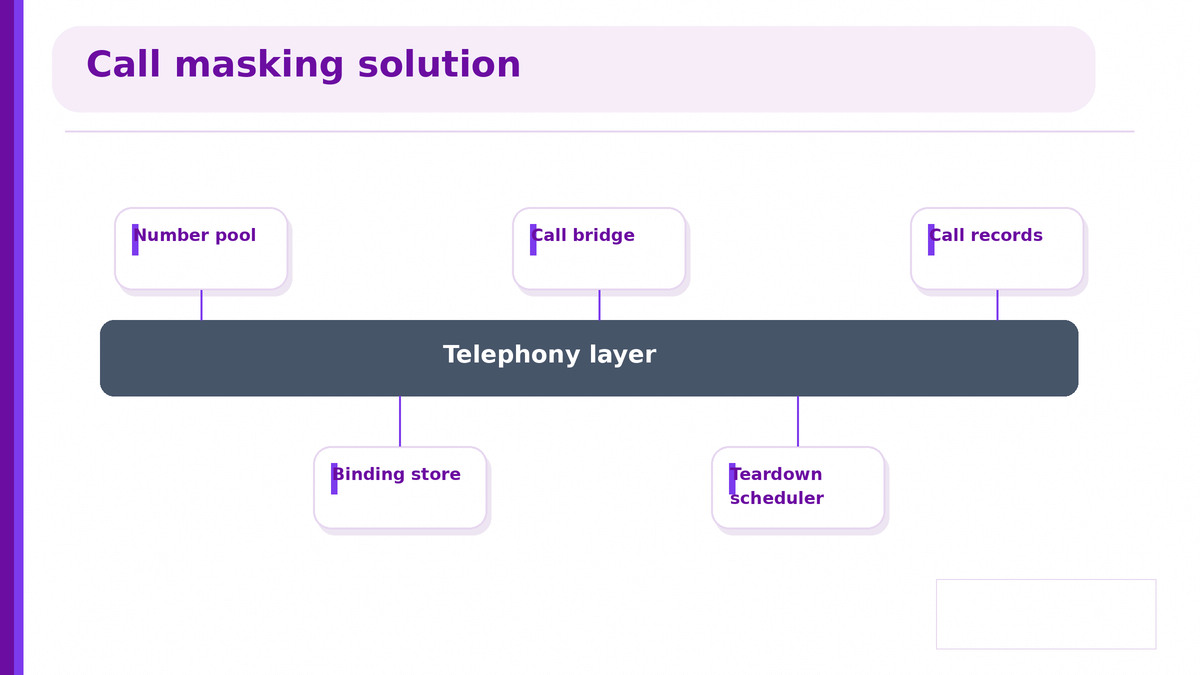
Table of Contents
A call masking solution is five parts somebody has to own
What masking is, when to release a binding and what it costs are covered in the number masking service India guide. This post is for the team deciding whether to build it rather than buy it, which is a different question.
A number pool, sized for peak concurrency, with numbers you can obtain and keep
A binding store, holding which two real numbers a proxy currently maps to
A call bridge, joining two legs in under a second
A teardown scheduler, releasing bindings reliably even when your app is down
Call records, retained, access controlled and disposable on schedule
Nothing on that list is intellectually hard. The difficulty is that all five have to work at 2am on a public holiday, and four of them involve a carrier relationship you do not have.
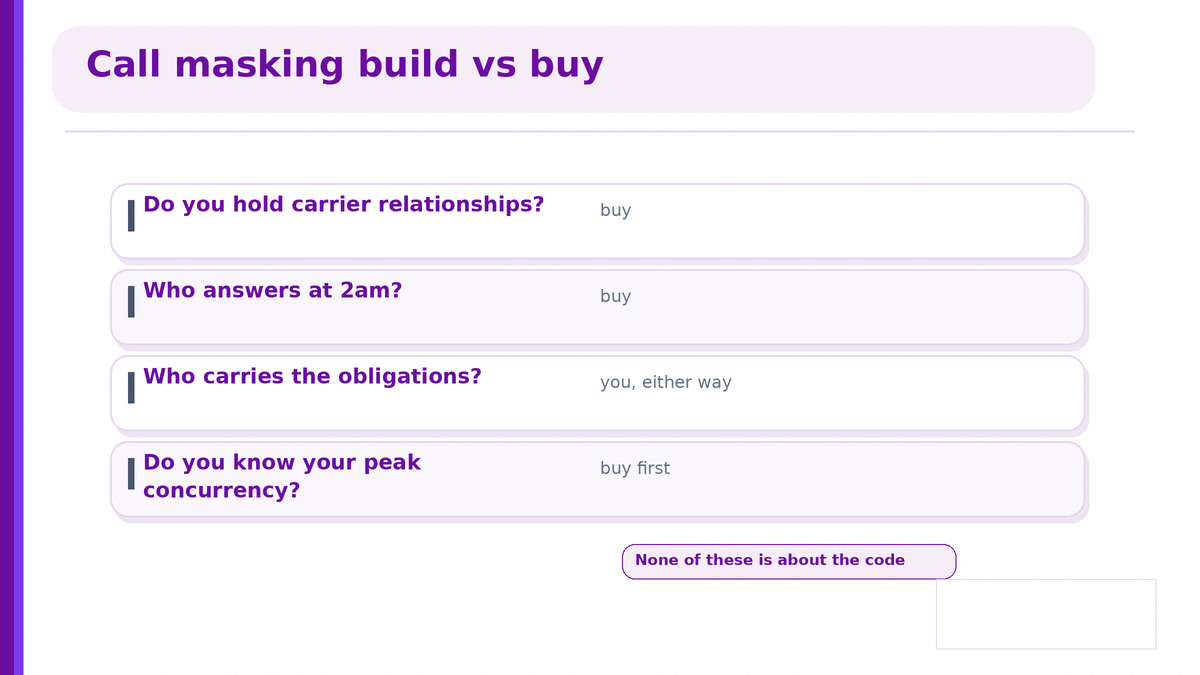
Call masking build vs buy, the four questions
None of them is about the code, which is why engineering led discussions about this reach the wrong answer.
Question | If the answer is no |
|---|---|
Do you hold carrier or telco relationships? | You are buying numbers through someone anyway |
Who answers at 2am when the bridge fails? | Buy, or accept silent outages |
Who carries the regulatory obligations? | You do either way, so this is not a reason to build |
Do you know your peak concurrency? | You cannot size a pool, so start by buying |
The honest default for almost every product team is buy, and build the layer above it. You own the business rules, which bindings exist and when they die, and the provider owns the numbers and the bridge.
The case for building
Real, but narrow. Very high volume where per minute pricing dominates your cost base, an existing telco relationship, or a regulatory position that requires the call path to stay inside your own infrastructure. If none of those apply, building a call masking solution is buying a maintenance obligation.
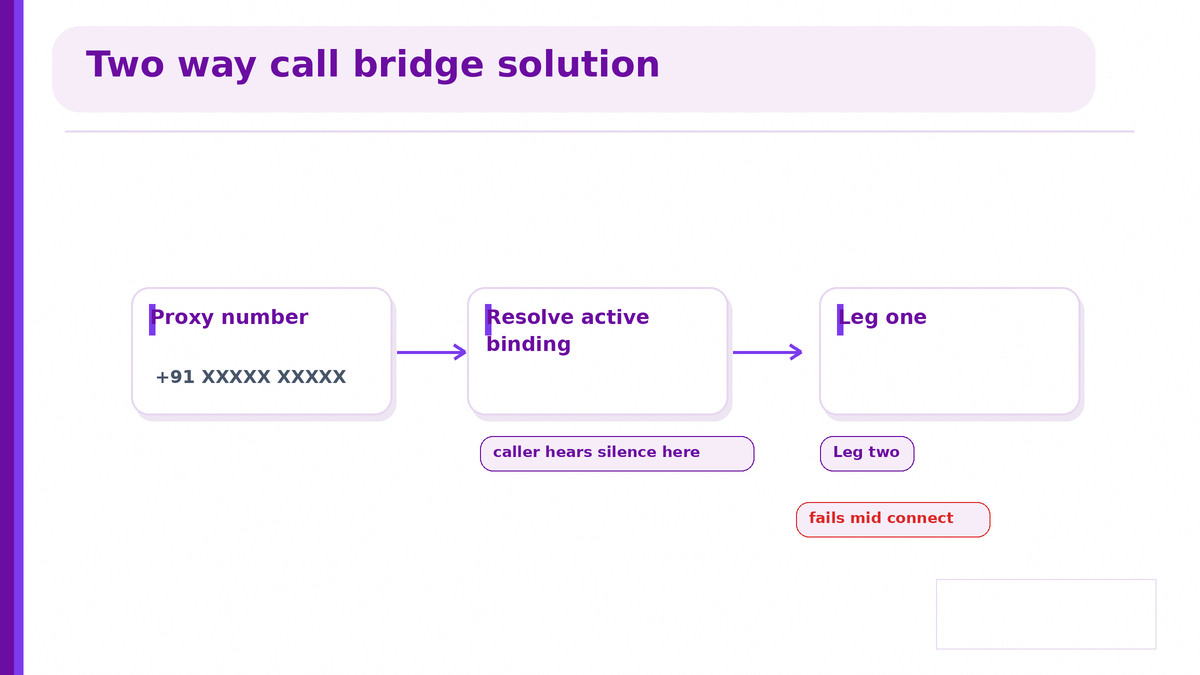
Two way call bridge solution, the part that is hard
Everything else is a database. The bridge is where a call masking solution stops being a routing rule and becomes telephony.
The lookup has to be fast. A caller is listening to silence while you resolve the binding
Both legs have to connect, and the second failing after the first succeeded needs a graceful answer
Caller ID on each leg has to show the proxy, not the real number, in every failure path too
Recording, if any, has to start after the disclosure, not before
The third point is where leaks happen. A bridge that shows the proxy normally and falls back to the real number on an error has a privacy incident built into its error handling, and it will only appear under load.
Test the failure paths specifically. Kill the second leg mid connect and check what the first party sees.
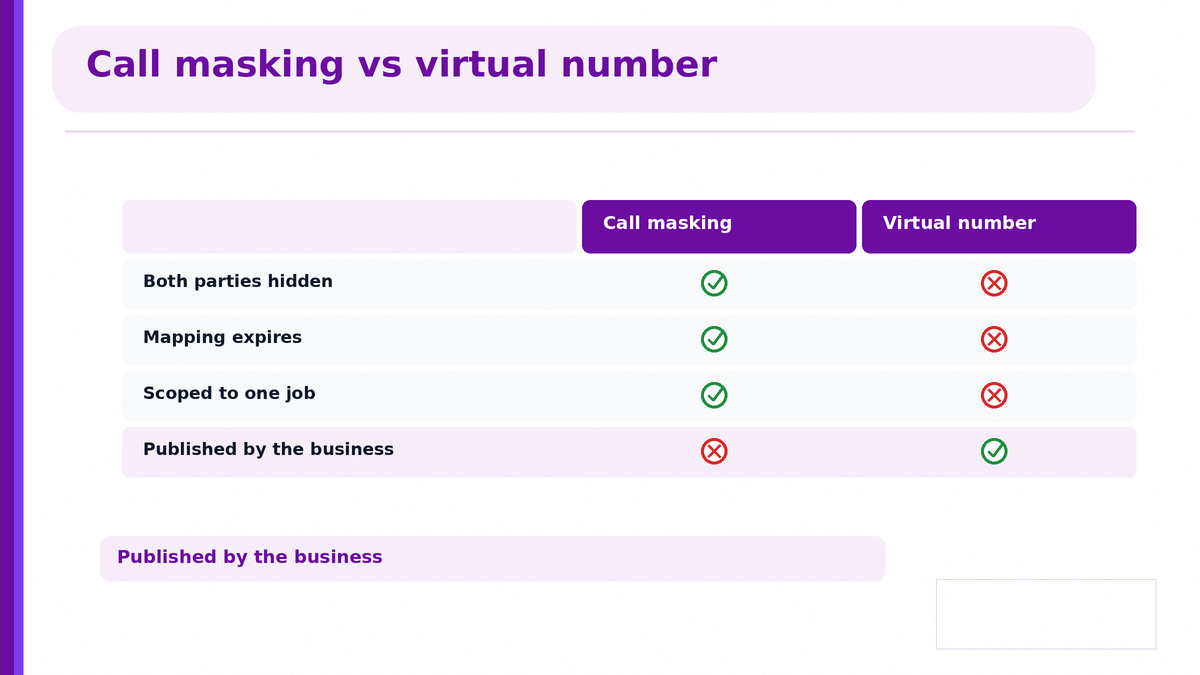
Call masking vs virtual number
These get conflated in procurement conversations, and buying the wrong one is a real outcome.
Call masking | Virtual number | |
|---|---|---|
Parties hidden | Both, from each other | Neither, the business publishes it |
Mapping expires | Yes, per transaction | No, it is permanent |
Scoped to one job | Yes | No |
Who publishes it | Nobody, it is issued privately | The business, on its website |
A virtual number is a published address that routes. A call masking solution is a temporary pairing that expires. The requirements documents for the two share almost nothing, and our virtual number for business India post covers the other side.
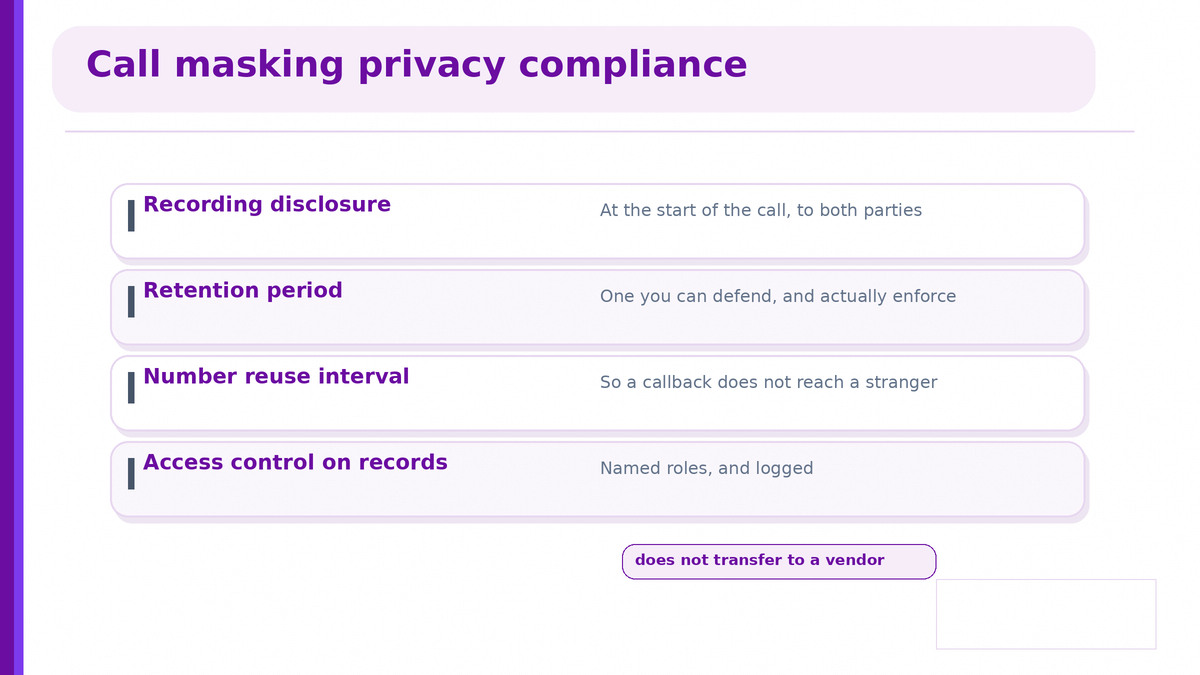
Call masking privacy compliance
The point most buyers get wrong: buying a vendor does not transfer the obligation. You remain the one who decided to record, to retain and to let staff read call records.
Recording disclosure. If you record masked calls, say so at the start of the call, to both parties
Retention period. Set one you can defend, and actually delete on schedule
Number reuse interval. How long a released number rests before reissue, so a callback does not reach a stranger's order
Access control on records. Who in your business can listen to a recording, and is that logged
India's data protection framework is published by the Ministry of Electronics and Information Technology, and the practical reading is that these four decisions are yours whichever way the build or buy question goes.
The reuse interval is the sharp one
Too short and a customer rings back a number now bound to someone else's order. That is both a privacy incident and a support ticket, and it is the failure mode that embarrasses a call masking solution most publicly. Ask for the interval in writing.
What to ask a vendor
What is the p95 latency on creating a binding, and what happens when the pool is exhausted?
What does the first party hear if the second leg fails mid connect?
How long does a released number rest before reissue?
Does the proxy carry SMS as well as voice, or will that traffic move to personal numbers?
Can we set retention, and does deletion actually happen on schedule?
The second question is the one that separates vendors, because it is about error handling rather than features, and it is where a call masking solution either protects privacy under failure or does not.
Common questions
Should we build or buy a call masking solution?
What is the hardest part of a two way call bridge solution?
Call masking vs virtual number, what is the difference?
Does a vendor take on call masking privacy compliance?
Why does the number reuse interval matter?
Where to start with Celitix
Celitix states the reuse interval in writing, carries SMS on the same proxy, and will tell you what the first party hears when a leg fails rather than leaving you to find out.
Ask Celitix about the failure paths