Gupshup alternative, four channel migrations not one
Table of Contents
What I will not tell you
I work for Celitix. I am also not going to quote another company's prices or limits, because the only sources are rivals' comparison pages, which contradict each other and the vendors' own sites. The reasoning is in how to tell a review from a sales page.
What this post covers is the part that makes a multi channel move different, which is that you are not running one migration but four.
A gupshup alternative is four migrations
If you only use WhatsApp, the four step job in the migration post covers it. If you run SMS, voice and RCS as well, each one moves on its own terms and three of them are harder than the WhatsApp one.
Channel | What makes it hard |
|---|---|
SMS | DLT headers and templates are re-registered, not transferred |
Number migration and template re-approval | |
Voice | Published numbers, and portability you may not have secured |
RCS | Sender brand verification, on its own timeline |
The voice row is the one that stops projects. If your published numbers are not portable, a gupshup alternative means changing numbers that are printed on your packaging and in your customers' phones, which is a different conversation entirely.
Move one channel at a time in any gupshup alternative
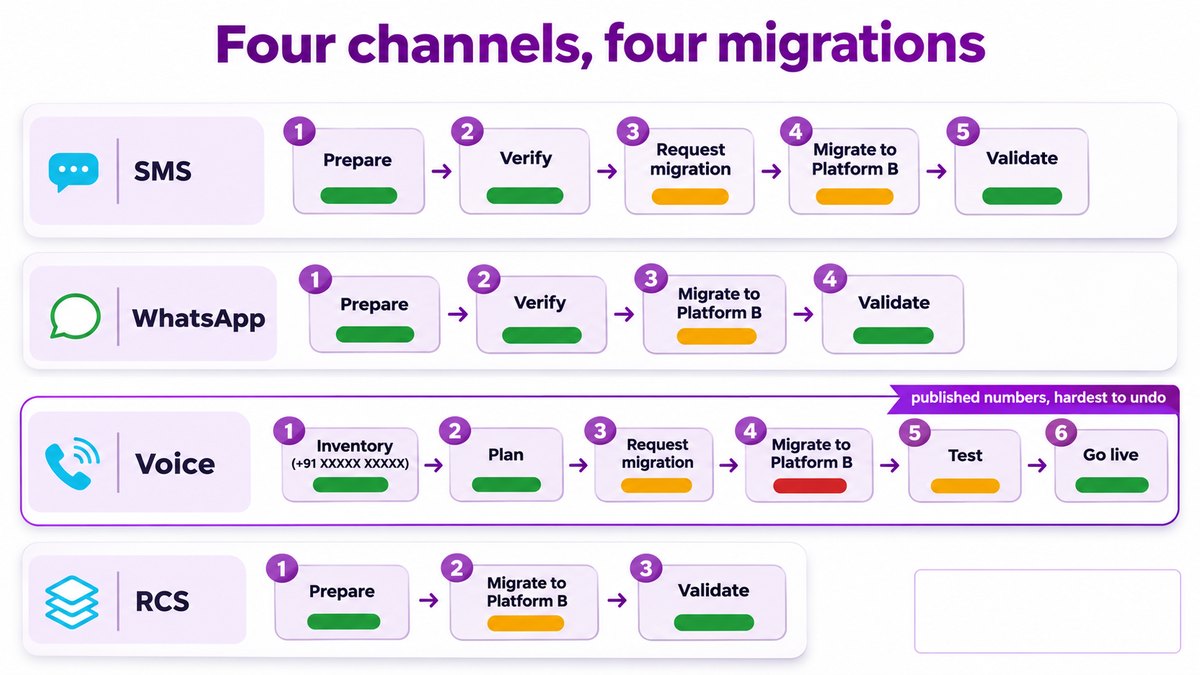
The single most useful decision in this kind of migration. Cutting all four over together gives you no fallback and no way to tell which channel caused a problem.
Start with the lowest risk channel, usually a low volume one, and prove the provider on it
Run in parallel for a period, with both providers live on different channels
Keep a rollback at every phase, which parallel running gives you for free
Move voice last, because published numbers are the hardest to undo
Parallel running costs you two sets of platform fees for a month or two. That is the price of being able to reverse a bad decision, and it is cheap against the alternative. Plan the switch from gupshup in phases rather than as a date.
What parallel running tells you
Real delivery performance on your own traffic, which no sales deck can give you. Run the same SMS campaign through both providers to the same list split in half, and compare delivered rates and failure reasons.
Gupshup vs other bsp providers, what cannot differ
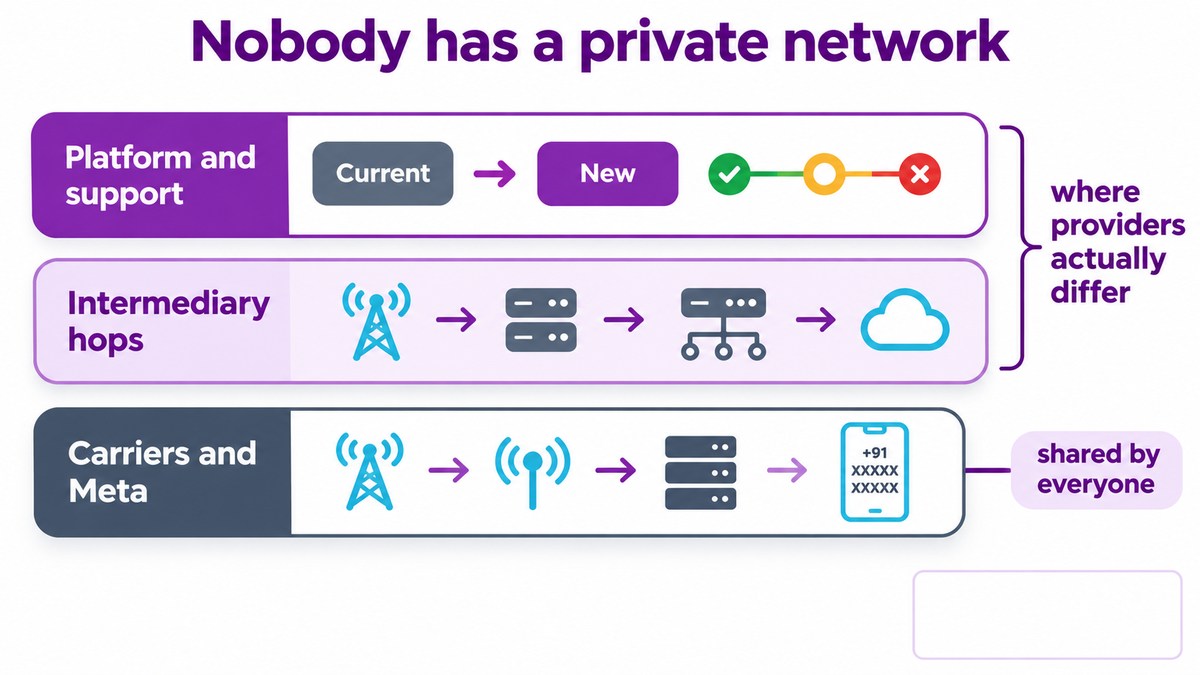
The carrier layer. Every provider reaches the same Indian operators and the same Meta API, so on gupshup vs other bsp providers nobody has a private network that delivers better in principle.
What differs is how many intermediaries sit between the API and the operator. Each hop adds latency and flattens the operator's failure sub reason, which is why two providers quoting the same rate can produce visibly different results.
Ask how many hops to the operator, per channel
Ask whether the sub reason is passed through or collapsed to a generic failure
Ask for p95 latency from India, at your peak hour, not an average
Ask what happens at 2am when a route breaks, and who answers
The second question is the most diagnostic. A provider that returns the operator's own sub reason is one you can debug with. One that returns unknown is one you cannot. The detail is in SMS delivery report tool.
Gupshup competitors india, and the DLT reality
On the SMS side, the headers and templates are registered against your entity on the DLT platform, not owned by your provider. That is good news and it is frequently misunderstood.
Your registrations are yours. What changes on a move is the provider's access to them, and the re-mapping work that follows.
Ask every gupshup alternative you are considering to spell out exactly what they need from you and how long the re-mapping takes. The process is in DLT registration process India, and TRAI sets the framework.
Cheaper alternative to gupshup, priced on delivery
Rate per message is the wrong comparison on SMS. Cost per message actually delivered is the right one, and the two can rank providers differently.
Measure delivered, not submitted, on your own traffic during parallel running
Split by traffic type, because promotional and transactional behave differently
Count the support cost of failures you cannot diagnose
Count the migration work across all four channels, once
A cheaper alternative to gupshup delivering a few percent less on transactional traffic is more expensive in every way that matters, because the undelivered messages are OTPs and order updates that generate support calls.
What no gupshup alternative fixes
DND scrubbing on promotional traffic. That is regulatory and applies to everyone
Template mismatch failures. Your template wording against your own registration
WhatsApp quality rating. Meta's, and it follows your number
RCS reach. Device and carrier support, not a provider capability
Separate those from what a provider controls before anyone signs. Three of the four follow you to any provider.
Common questions
Why is a gupshup alternative four migrations?
Should I move all channels at once?
Do my DLT registrations transfer when I switch from gupshup?
How should I compare gupshup competitors india?
Is a cheaper alternative to gupshup actually cheaper?
Where Celitix fits
Celitix will tell you how many hops sit between the API and the operator per channel, passes the operator sub reason through rather than flattening it, and will run a split test against your current provider during parallel running.
Ask Celitix for a split test